As electric vehicles (EVs) pick up pace around the globe, the need to develop better, more sustainable battery technologies is peaking. Lithium-ion (Li-ion) batteries right now lead the EV market but sodium-ion batteries are rapidly coming up as a practical and commercially relevant alternative. Their appeal stems from notably lower raw material costs, greater global material availability, and recent advancements that improve energy density and performance. The focal point of both lithium-ion and sodium-ion battery evolution is the role of the anode, which directly impacts energy density, cycle life, and charge performance.
Graphite in Lithium-Ion: Proven, but Under Pressure
Graphite has been the main anode in lithium-ion batteries for decades because of its layered crystalline structure, trusted electrochemical behavior, and low cost. But as battery applications diversify and performance expectations rise, graphite’s modest capacity and vulnerability to supply constraints are becoming clear hurdles. As a reply, companies such as General Motors have made long-term investments into synthetic graphite supply chains, such as their 2023 deal with Novonix. This shows the strategic importance of anode materials. Also, researchers continue exploring more advanced materials to break through graphite’s performance ceiling.
Silicon and Tin-Based Alloys: High Potential with High Risk
Silicon and tin-based alloy anodes have attracted much interest because of their much higher theoretical capacities. Silicon, for instance, can store nearly ten times the lithium of graphite but suffers from extreme volume expansion during cycling, which leads to electrode fracture and rapid capacity fade. Tin and antimony-based alloys give similarly high capacities but face comparable mechanical stability issues. Companies like OCSiAl are follow nanomaterial solutions, such as graphene nanotube networks, to mitigate these expansion effects. Despite these challenges, continued innovation in composite designs and flexible binders is gradually bringing these materials closer to real-world viability.
Anode Advancements: Hard Carbon Leads, Alloys Evolve
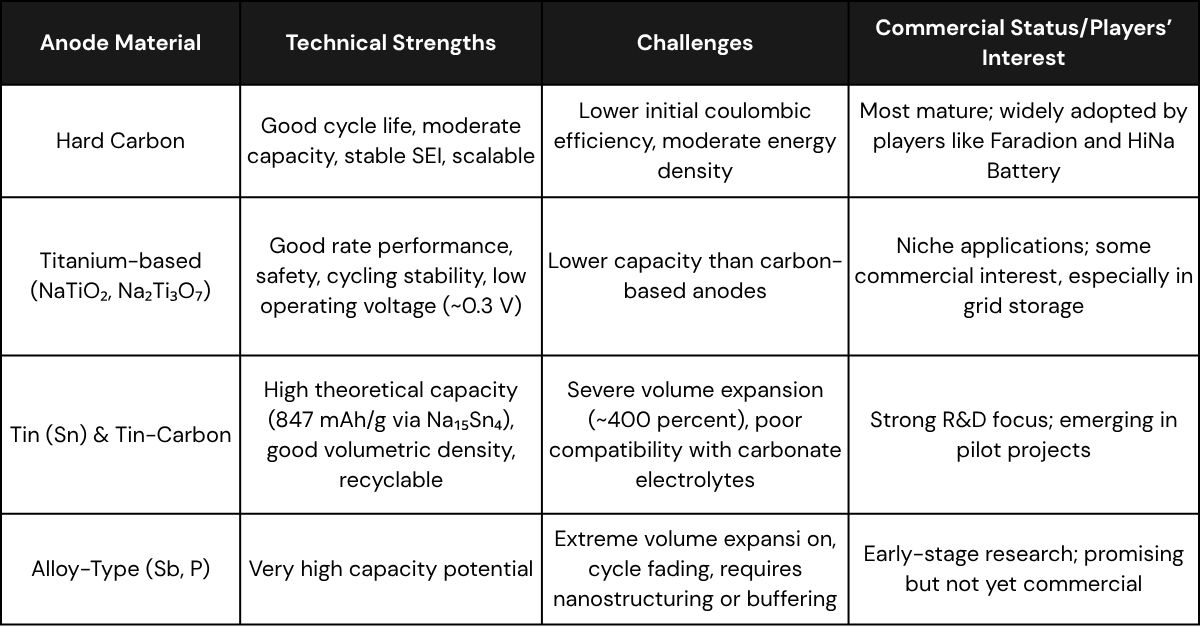
At the center of sodium-ion battery performance is the development of anode materials in line with sodium’s larger ionic radius. Graphite, which works well for lithium, cannot intercalate sodium effectively. The result? Battery manufacturers chose hard carbon, an amorphous form of carbon derived from biomass or polymers. Hard carbon has proven to be the most commercially workable anode material for sodium-ion cells. It gives a stable solid-electrolyte interphase (SEI), moderate volume expansion, and scalable production. It is right now the preferred choice of industry leaders such as CATL, Faradion, and HiNa Battery.
Also, researchers are adapting tin and antimony-based alloy anodes, materials also explored in lithium-ion development, to sodium-ion systems. These alloys offer much higher theoretical capacities, with tin reaching up to 847 mAh/g through Na₁₅Sn₄ formation and delivering strong volumetric energy density. They are also recyclable and relatively abundant. However, they suffer from severe volume expansion during cycling, reaching up to 400 percent in the case of tin. This leads to mechanical degradation and poor compatibility with standard carbonate-based electrolytes. While not yet commercial, these materials are the focus of strong R&D activity and are already entering pilot-scale demonstrations.
Other materials such as titanium-based compounds like NaTiO₂ and Na₂Ti₃O₇ are also under investigation for their excellent rate performance and safety characteristics. Although they offer lower capacities yet, they are more suited to niche grid storage applications. Alloy-based materials like antimony and phosphorus are also being studied, but their extreme volume changes and short cycle life have so far limited them to early-stage research.
Anode Material Comparison
Commercial Integration and Market Activity
The effect of anode innovations is now being felt in real-world sodium-ion deployments. Sodium-ion batteries have crossed key technical challenges, made possible largely because of advancements in anode materials like hard carbon and tin composites. At the same time, they are making their way into commercial platforms. Sodium is much more abundant than lithium, constituting about 2.74 percent of Earth’s crust versus lithium’s 0.0065 percent. Its global distribution is more balanced, which reduces reliance on geopolitically concentrated resources and contributes to 30-40% lower raw material costs at scale.
In 2024, CATL brought in its second-generation sodium-ion battery. It reaches up to 200 Wh/kg energy density, operates down to -40°C, and achieves up to 20,000 cycles at 70 percent capacity retention. These specifications rival LFP batteries, particularly for cold-climate and fleet applications. Automakers are already accepting this potential. Lynk & Co launched its 900 model featuring CATL’s hybrid “Xiao Yao” battery system. This system combines lithium-ion and sodium-ion cells to deliver a 400 km range and 4C fast charging. Tesla is also reportedly exploring sodium-ion chemistry for its anticipated $25,000 mass-market EV, which further signals industry interest.
Sodium-ion technology is also being adopted in light electric vehicles and commercial transport. Sany Group successfully tested an 8 kWh sodium-ion pack in a hybrid dump truck. Yadea and Huayu Na Battery have released a sodium-ion e-bike platform with 15-minute charging capability, while Oppein has launched a mass-produced model powered by Pangu’s 72V20Ah sodium battery.
Forecasts hint that the global sodium-ion battery market will grow at a compound annual growth rate exceeding 14 percent from 2024 through 2031. But this growth is not without challenges. More than 90 percent of global sodium-ion battery manufacturing capacity is currently based in China, which introduces a concentration risk. Setbacks such as Kingshine’s canceled 6 GWh facility in Jiangxi Province show the volatility in scaling up new battery technologies. Also, while sodium-ion is cheaper in material cost today, long-term cost advantages depend on upcoming manufacturing efficiencies, supply chain localization, and continued declines in processing costs. If lithium prices remain low, sodium-ion will face a narrower window of price competitiveness.
Conclusion: A Near-Term Reality, Not a Distant Dream
Sodium-ion batteries have moved decisively out of the laboratory and into the early stages of commercial adoption. With support from key manufacturers and continued advances in anode materials, especially hard carbon and alloy-based designs, sodium-ion batteries are set to complement, and in particular use cases, challenge the usage of lithium-ion systems. Their strengths in cost, sustainability, low-temperature performance, and raw material availability make them particularly suitable for light electric vehicles, fleet applications, and stationary storage. The coming five years will be critical in determining how far this emerging chemistry can go and how effectively it can scale to meet global electrification demands.