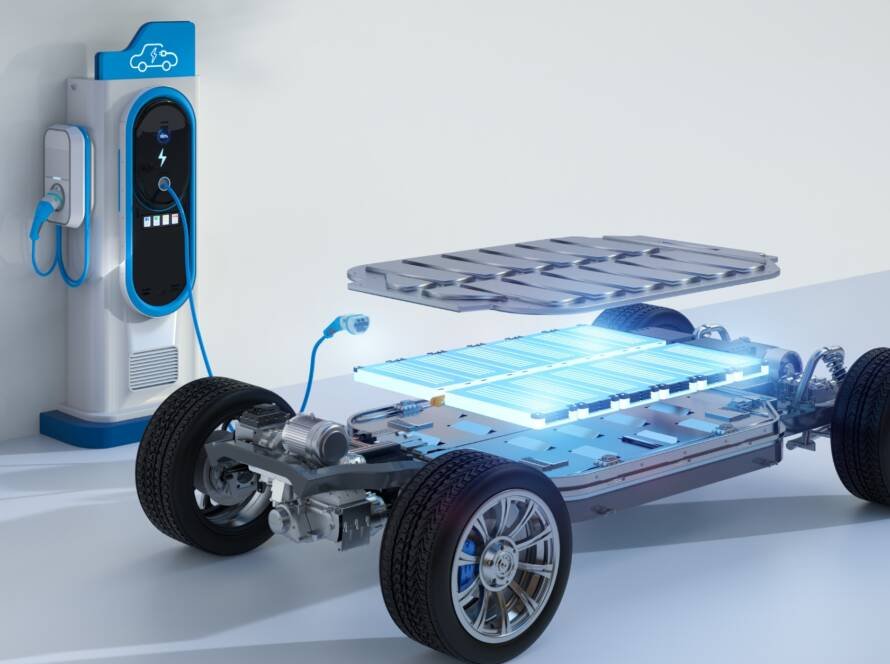
The Promise of Solid-State Batteries
Conventional lithium-ion batteries have revolutionized portable electronics as well as electric mobility. But they come with ingrained limitations. Chief among these are flammability, reliance on volatile organic liquid electrolytes, and constraints in energy density. As the demand for safer, longer-lasting, as well as faster-charging energy storage solutions is on the rise, solid-state batteries have come up as a transformative technology. By replacing flammable liquid electrolytes with solid materials, solid-state batteries promise enhanced safety and also support for lithium metal anodes, which can notably boost energy density.
Among the various types of solid electrolytes under study, nano-sulfide solid electrolytes stand out. For what? For their remarkable ionic conductivity, compatibility with lithium metal, and the ability to form ultra-thin separator layers. These unique characteristics put them at the leading position of innovation in solid-state battery development.
Understanding Nano-Sulfide Solid Electrolytes
Nano-sulfide solid electrolytes are finely engineered sulfide-based compounds. These are usually processed to achieve particle sizes on the order of hundreds of nanometers. This nanoscale structuring enhances their electrochemical performance in quite a few ways. First, these materials show high lithium-ion conductivity, usually exceeding 10⁻³ S/cm, which is comparable to or better than many liquid electrolytes. Second, they are chemically compatible with lithium metal, a critical feature for enabling next-generation anode materials without much dendritic growth. Third, their nanoscale morphology allows them to form extremely thin separator layers. Sometimes as thin as 10 micrometers, contributing to higher energy density in the full cell architecture.
Also, the process of nanosizing improves interfacial contact with both anode as well as cathode materials. This enhances diffusion pathways for lithium ions. Also, it reduces the interfacial resistance that usually plagues solid-state systems. Combined, these advantages make nano-sulfide electrolytes a lucrative solution for a broad spectrum of high-performance applications.
Material Focus: Performance and Innovation
The family of nano-sulfide electrolytes entails several prominent chemistries. Each comes with distinct advantages and trade-offs. Among these are Li₁₀GeP₂S₁₂ (LGPS), Li₇P₃S₁₁, and Li₆PS₅Cl. Each of them represents a unique way to optimize conductivity, processability, and scalability.
The following table compares the performance and challenges of these key materials:
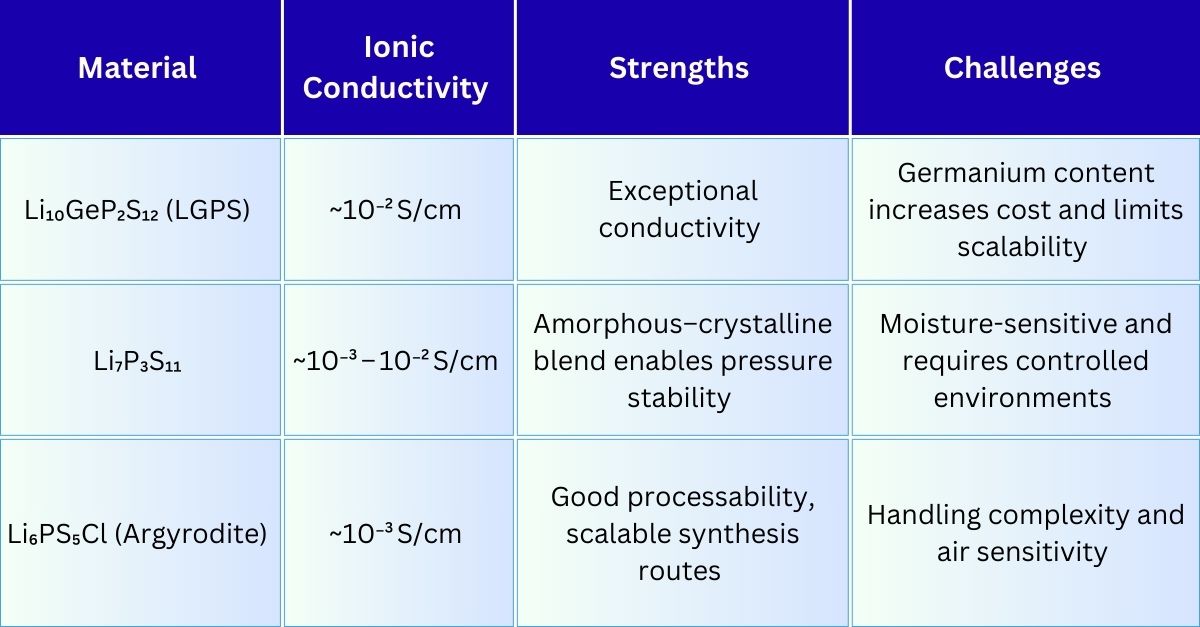
Recent innovations have addressed some of these issues. For example, researchers have showed that coating Li₆PS₅Cl particles with hydrophobic thiol groups notably better their resistance to moisture. These surface-engineered sulfides maintain high ionic conductivity even after prolonged exposure to ambient humidity. And this is an essential step toward practical, large-scale manufacturing. Similarly, engineered interfaces and protective interlayers are being developed to suppress lithium dendrite growth and ensure stable cycling performance in full cells.
Industry Momentum: Spotlight on Ampcera
Ampcera, a U.S.-based advanced materials company, has come up as a clear torchbearer in the commercialization of nano-sulfide solid electrolytes. In May 2025, Ampcera brought in a new line of nano-sulfide powders that have already attracted global attention. These materials boast ionic conductivities above 10⁻³ S/cm and come in particle sizes optimized for ultra-thin separator formation, usually less than 10 micrometers in thickness.
The company’s technology has found immediate relevance in electric vehicles, aerospace systems, and defense applications. This is because it is where high energy density and intrinsic safety are paramount. In less than 3 months, Ampcera reported validation and purchase orders from over 200 OEMs and battery manufacturers all around the globe. The company’s usage of scalable roll-to-roll processing methods and its involvement in U.S. Department of Energy projects also show its leadership in translating lab-scale innovation into commercial reality.
Of interesting note is Ampcera’s work on dendrite-suppression membranes. These membranes are engineered to complement lithium metal anodes without letting go of conductivity. This innovation lays the path for the adoption of lithium metal over a wider range of devices. Also, it could unlock major gains in energy density and cycle life.
Competitive Landscape and Global Activity
The push to commercialize sulfide-based solid electrolytes is a global endeavor. Much of the activity is concentrated in the United States, Japan, and South Korea. In Japan, NGK Insulators has used its ceramic processing expertise to scale up sulfide-based electrolytes. Toyota and its joint venture with Panasonic (PPES) have amassed a formidable patent portfolio. Also, they are believed to be running pilot-scale production lines. Korean giants Samsung SDI and the Samsung Advanced Institute of Technology are also heavily invested in sulfide electrolyte research. This is particularly for use in solid-state electric vehicle batteries.
In the United States, Solid Power has developed sulfide-based cells and entered into strategic partnerships with automotive leaders like BMW and Ford. On the other side, companies such as Sumitomo, Mitsubishi, ProLogium, and Ohara continue to explore niche applications and contribute to the growing body of sulfide-related intellectual property. This international focus has led to a rapid maturation of the technology and increased pressure to solve remaining hurdles related to manufacturing and stability.
Challenges to Commercialization
Of course, there is a promise, but nano-sulfide solid electrolytes are not without their hurdles. Prime among these is moisture sensitivity. Sulfides react readily with water vapor to form hydrogen sulfide gas and degrade their ionic conductivity. Now, this necessitates the use of dry rooms and inert atmospheres during processing. However, surface treatments and novel encapsulation techniques are beginning to make ambient processing feasible.
Dendrite formation is another critical concern. This is especially true when using lithium metal anodes. Sulfides usually perform better in suppressing dendrites compared to oxides or polymers. But they are not immune. Research into composite interlayers and self-healing interfaces is in process to address this issue.
The scalability of nano-sulfide production also poses a technical and economic challenge. Producing nanoscale powders at industrial volumes needs careful control over particle size and composition, as well as phase purity. Ampcera’s success with roll-to-roll processes and scalable synthesis routes shows an important step forward. But broader adoption will need robust supply chains and cost cutting.
Thermal and chemical stability also stay concerning. This is particularly for operation at high voltages or under fluctuating environmental conditions. Making sure compatibility with high-voltage cathodes while maintaining performance across a broad temperature range is important for widespread acceptance.
Outlook: What’s Next?
Looking ahead, several developments could unlock the full potential of nano-sulfide solid electrolytes. Researchers are actively looking for cost-effective options to germanium-based systems. For example, LGPS, with the target of retaining high ionic conductivity without the associated expense. Hybrid electrolyte systems that bring together the strengths of sulfides with polymers or oxides are also gaining momentum, giving tailored mechanical properties and improved safety.
Equally promising is the move toward air-stable sulfide processing. Advances in molecular coatings and interface engineering may allow for ambient manufacturing, removing one of the most difficult-to-get-rid-of barriers to commercialization. Besides electric vehicles, nano-sulfide solid electrolytes could also find use in high-performance applications. For example, drones, medical implants, and satellite systems, where space and safety are critical hurdles.
Conclusion
Nano-sulfide solid electrolytes mark an important breakthrough in the ongoing evolution of solid-state batteries. The conductivity is on par with liquid electrolytes. Also, there is compatibility with lithium metal and the ability to support ultra-thin architectures. Thus, these materials are set to redefine the performance boundaries of energy storage. Companies like Ampcera are leading the charge, translating academic discoveries into real-world products and establishing the infrastructure needed for large-scale deployment.
While challenges remain in terms of moisture sensitivity, dendrite suppression, and manufacturing scale, recent advances suggest these barriers are surmountable. As innovation continues across the ecosystem, from material design to full-cell integration, the vision of high-performance, safe, and energy-dense solid-state batteries powered by nano-sulfide electrolytes is becoming increasingly tangible.