The Forgotten Layer in Wearable Tech In the surge of innovation around wearables, biosensors, and e-skin technologies, the skin itself has often been treated as an afterthought. While miniaturising circuits and improving sensor resolution have received most of the attention, the materials that physically connect these devices to the human body have advanced more slowly. Poor adhesion, discomfort, and inconsistent readings continue to affect performance, especially during prolonged wear or intense physical activity. Device drop-offs, skin irritation, and user non-compliance are not just usability issues. They create data reliability problems and even commercial risks. In 2024 and 2025, there is a noticeable shift from electronics-first to interface-first design. At the center of this shift is a group of bioinspired polymers that are designed not just for function, but for true compatibility with human skin.
Functional Needs at the Skin–Device Interface
The skin is a soft, elastic, moisture-rich, pH-variable, and constantly renewing surface. It behaves nothing like metal, glass, or plastic, which means bonding electronics to skin presents a special set of hurdles. The interface must stretch and move with the skin, remain breathable, and maintain adhesion over time without causing trauma when removed. It must also avoid triggering irritation or allergic responses. A good skin–device interface should be able to keep sensors in place while preserving comfort and delivering clean signal data. This positions the material interface, not just the sensor, as a central point of innovation.
Bioinspired Adhesion Mechanisms
Design cues from biology have led to some of the innovative adhesion strategies now being applied or actively explored for wearable technologies. Gecko-inspired dry adhesives, based on van der Waals interactions, have led to micropatterned silicone surfaces that grip firmly yet release cleanly without residue. In 2025, researchers demonstrated a magnetically switchable gecko-patterned adhesive capable of reversible adhesion via the controlled bending of surface microstructures. This gives new potential for rewearable skin patches. In 2024, a PDMS film with mushroom-shaped micropillars was presented as a flexible, biocompatible interface for skin-mounted sensors and stretchable electronics. Earlier studies also showed that gecko-inspired, conductive silicone patches could maintain reliable ECG readings over multiple wear cycles. This is true even in wet conditions.
Other nature-inspired approaches are suction-based adhesion modeled after octopus suckers, which is being developed for use in humid or wet environments. Though still primarily in the research stage, these designs do promise future wearable devices. Mucus-inspired hydrogels, which combine softness with controllable stickiness, are also gaining attention for temporary skin adhesion, particularly where moisture management is important. While many of these materials remain at the lab or prototype level, they are redefining how devices can comfortably and securely connect with the human body.
Advanced Polymer Classes Used
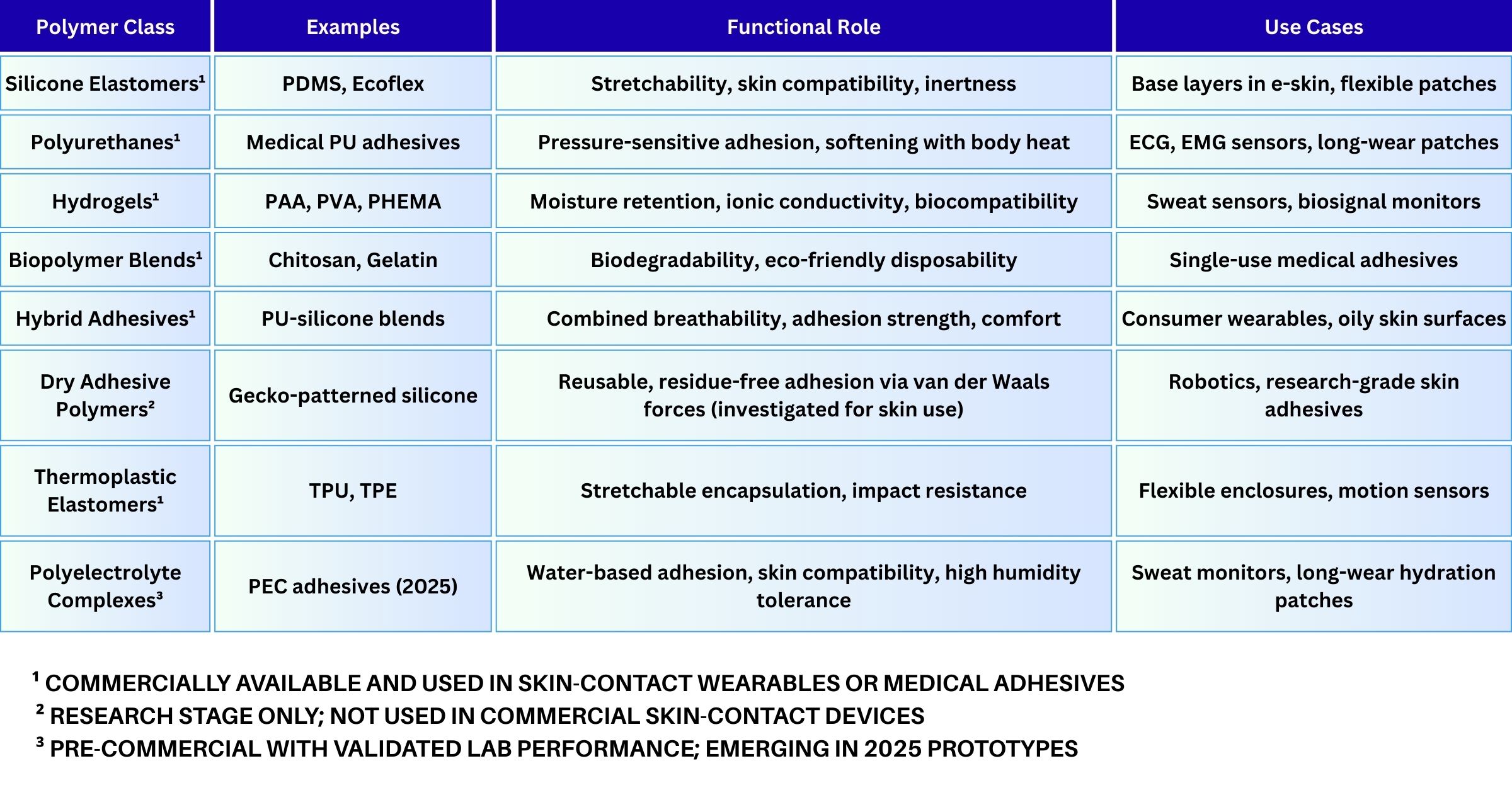
Several types of polymers are now used to meet the needs of skin-integrated devices. Silicone elastomers such as PDMS and Ecoflex are quite widely used for their stretchability and skin safety. Polyurethane adhesives are commonly used in ECG and EMG patches because of their pressure-sensitive properties and thermal responsiveness. Hydrogels like PAA, PVA, and PHEMA support ionic conductivity and moisture management, making them useful in biosensors and sweat monitors. Biopolymer blends such as chitosan and gelatin are appearing in dissolvable or biodegradable formats for eco-friendly medical patches. These materials are often combined in layered structures where mechanical, chemical, and biological properties must all be optimised together.
Polymer Classes Used in Skin-Integrated Wearable Devices
 Commercial and Research Examples Recent product releases show that skin-friendly polymer interfaces are now becoming central to wearable device design. In 2023–2024, Epicore Biosystems brought in the Gatorade Gx Sweat Patch, a disposable, breathable biosensor for hydration tracking. The patch uses a skin-friendly adhesive and is FDA-registered for consumer use. In April 2024, Epicore Biosystems brought in the Connected Hydration Patch. It is a skin-integrated wearable made for industrial and military applications. Built to perform in high-sweat, high-stress environments, the patch features a hypoallergenic adhesive that maintains a secure seal during prolonged activity. It continuously tracks sweat volume as well as electrolyte loss, giving real-time hydration alerts through a connected mobile dashboard. In July 2025, Epicore secured a US 1.2 million USD AFWERX Phase II contract. It is to support hydration readiness in U.S. Air Force training environments. This also validates the patch’s role in mission-critical human performance monitoring.
Also, in late 2023, DuPont brought in the Liveo Soft Skin Conductive Tape 1‑3150. This silicone-based adhesive tape supports ECG and EEG applications, giving gentle, repositionable skin contact over multiple days of wear. Another promising alternative came up in 2025 with the development of a water-based polyelectrolyte complex (PEC) adhesive, specifically engineered for wearable medical devices. This PEC adhesive matches the adhesion strength of commercial medical tapes like Tegaderm while notably improving skin compatibility, especially under moist and sweaty conditions. Both examples reflect the growing emphasis on adhesives that combine secure, long-term contact with biocompatibility and comfort.
More recently, in mid-2025, researchers brought in a water-based polyelectrolyte complex (PEC) adhesive derived from industrial by-products. Made specifically for wearables, it matches the adhesion performance of commercial medical tapes such as Tegaderm while significantly improving skin compatibility under moist and sweaty conditions. The adhesive uses a bio-based formulation that avoids common irritants, supporting both comfort and sustainability goals in next-generation biosensor design.
Engineering Skin-Like Interfaces: Materials and Fabrication Trends
New fabrication techniques are improving the way these materials function in wearable formats. Microperforation and solvent casting are now used to make breathable films. Also, materials with gradient stiffness are being used to transfer mechanical stress gradually from rigid devices to soft skin. Printed hydrogel patterns can apply adhesion only where needed. Thereby, it increases comfort. Stretchable thermoplastic encapsulants are being designed to deform with the skin and maintain stable signals during motion. These developments are not cosmetic. They directly affect data quality, device safety, and user adoption.
Challenges in Long-Term Bio-integration
No doubt there is progress but hurdles are still there. Adhesive materials can cause skin damage with prolonged use. It is especially true in sensitive or elderly populations. Sweat and skin oils can build up under the device and interfere with adhesion or sensor function. Uneven pressure on the skin can cause signal noise or dropouts. On top of this, all skin-contact materials must pass ISO 10993 testing for irritation, sensitisation, and cytotoxicity, which adds cost and complexity to development. Companies are actively working on these issues, but they remain key roadblocks to truly long-term skin integration.
Outlook: Toward Next-Generation Polymer–Skin Interfaces
In the coming years, new materials will focus on performance as well as on sustainability and user control. Biodegradable adhesives that break down after use are being explored to reduce medical and consumer waste. Smart adhesives that release on command through heat, light, or chemical triggers are in early development. Breathable films that can regulate temperature and moisture are also on the lookout. As these technologies mature, device makers will need to rethink their entire approach to design. The skin is not a passive surface. It is an active, dynamic environment. Materials that can adapt to it will define the next wave of innovation in healthcare, sports, and consumer electronics.
This article was originally published in Med-Tech Insights.