Like all other personal care segments, the haircare industry is heavily influenced
by consumer demands and changing requirements. The last few years have seen
a significant shift in consumer preferences from drugstore goods to more environmentally friendly options. The market is inclined towards multi-functional products, whether in terms of usage or ingredient benefits. This applies to shampoos,
conditioners, hair sprays, mousse, creams, gels, and other hair styling products.
The market for cosmetics and personal care is witnessing a boom in hair health and hair loss products, as well as a rise in interest in natural ingredients, fermented products, and emerging technologies like
exosomes. In 2021, the global market for shampoos and
conditioners was valued at over US$60 billion, and it is
projected to grow at a CAGR of ~4% over the next five
years. APAC is the largest hair care market and an active
exporter to regions such as Europe, as the K-beauty craze
is at its peak. Personalised products, regardless of their
formulations, are more appealing to the American populace. Globally, however, people favor and use clean beauty
products.
The ingredient breakdown:
Functional and Active
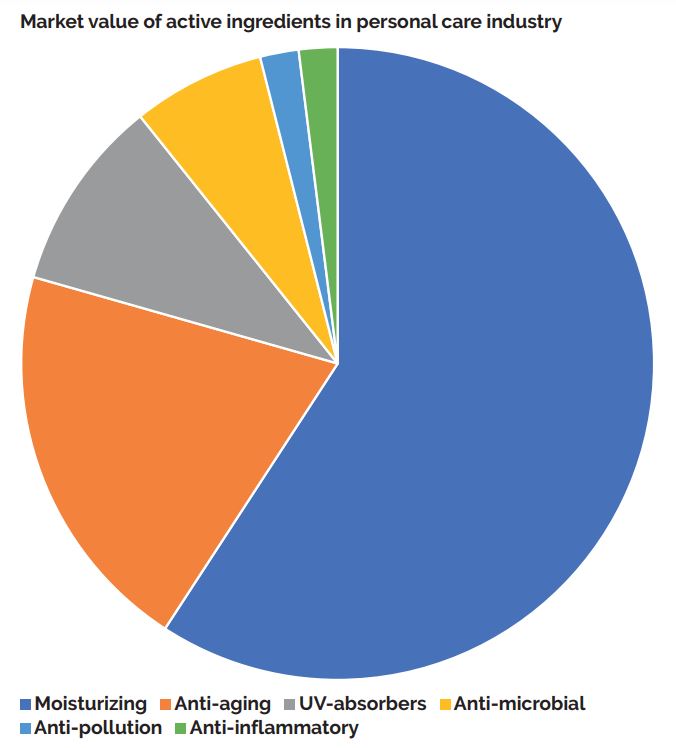
While active ingredients are added to haircare products
to improve their performance, functional ingredients
make up the majority of the product’s formulation. For
instance, moisturizing ingredients – especially in shampoos and conditioners – are highly desired in hair care
products. To provide that smooth texture, the formulation includes ingredients like hyaluronic acid, plant-based
oils, and humectants. Other categories of active ingredients
desired in hair care include anti-dandruff, anti-oxidants,
anti-aging, UV absorbers, etc. Because of the high levels
of pollution and the necessity of deeply cleaning the scalp,
anti-pollution ingredients are also highly sought after in
hair care products, particularly in APAC. Antioxidants,
minerals, and plant-based products like algae are therefore frequently included in formulations. UV absorbers
are also highly desired in haircare applications because
of increased concerns of premature graying, dryness, etc.,
due to sun damage.
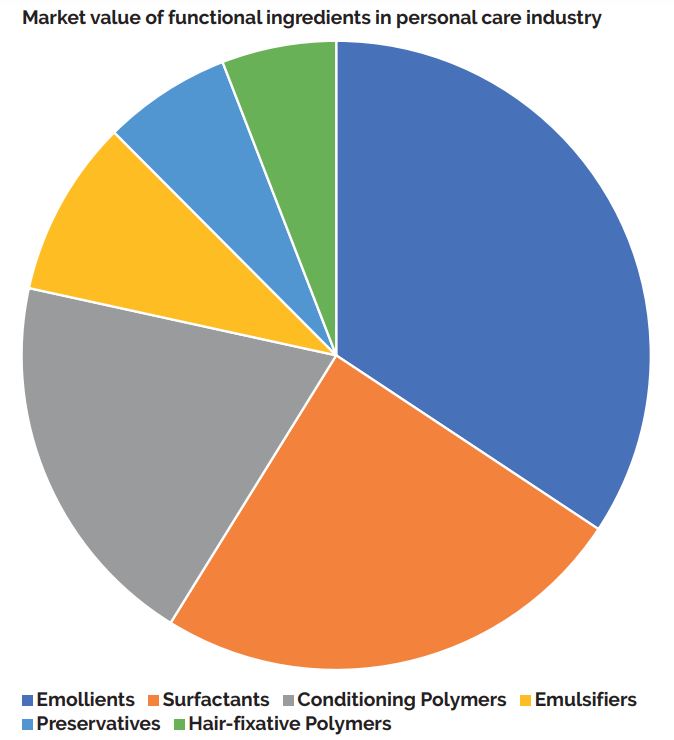
When it comes to functional ingredients, conditioning polymers (proteins, peptides, silicones, etc.) are one of the
top categories used in shampoos and conditioners, with a
market value of over ~$1,500 Mn in 2021. Silicone-based
polymers (Dimethicone, Dimethiconol, Cyclomethicone,
Dimethicone Copolyol, Silicone Resins, and Siloxane
Copolymers) account for a huge stake in the category.
However, consumer interest in natural ingredients, such
as vegetable oil-based biodegradable conditioning polymers, has been steadily increasing. Typically, jojoba, argan,
shea, and cocoa butter are used to make these substitutes,
offering the same or comparable performance. Leading
specialty chemical companies1,2 have been launching their
100% vegetable oil-based emollients, ideal for providing
conditioning and smoothness.
Surfactants and emollients are popular ingredients among
formulators because they are used in a variety of applications, including shampoos, conditioners, and hair styling
products. Both of these ingredient categories can be used
with other ingredients, thus making hair products multi-functional. A brand3
recently launched a hair and body
cleanser using sulfate-free surfactants, a multifunctional
ingredient rheology modification, improving the suspension and improving overall formula stability. The surfactant
market is witnessing a shift towards mild bio-based and
sulfate-free surfactants such as Sodium Lauroyl Methyl
Isethionate and Cocamidopropyl Betaine, which are preferred in clean formulations due to their gentle nature. This
shift is attributed to the clean beauty trend and the high
demand for natural products worldwide.
A premium class of ingredients found mostly in styling
products is hair fixative polymers. Through the formation
of a thin layer that protects the hair from environmental
factors, they help maintain the integrity of the hairstyle.
Resyn, amphomer fixative polymers, and acrylic co-polymers are a few of the most commonly used ingredients.
Owing to the need for premium performance, the transition
from artificial to natural ingredients is happening more
slowly in this segment.
Emollients have the highest market
penetration in the hair care category
In addition to these groups, emulsifiers, thickeners/opacifiers, and rheology modifiers are some of the most sought-after ingredient categories among formulators of hair care
products. However, formulators have been employing
interchangeable ingredients, which essentially means using
multifunctional ingredients, to cut down on the number
of additions needed to produce the desired result. It also
marginalizes the compatibility issues which are evident
due to use of a diverse range of ingredients in the formulations. Cocamidopropyl Betaine, a popular ingredient in
shampoos, is one of the most commonly used multifunctional ingredients. It serves as a cleanser, conditioner, foam
booster, and mild surfactant. This particular ingredient is
new to the market due to the growing popularity of natural and less harsh personal care products. A US-based
specialty chemicals company4
has introduced a new type
of multifunctional polymer in the haircare category. The
product is a biodegradable alternative, providing softness,
smoothness, shine, and wet compatibility.
Preservatives are essential components, and parabens are
among the most commonly used types. The demand for
this particular ingredient has gradually declined due to
side effects that may be linked to hormone disruptions
and health problems such as breast cancer. Many regions
have put limits on the use of parabens that are not suitable for hair/ scalp health. Similarly, other well-known
preservatives like phenoxyethanol, sorbic acid, benzoic
acid, and others have been put under usage restrictions.
Preservative alternatives are hard to come by, and it can be
difficult to mimic their functionality naturally. Consumers
today have a preference for preservatives that do not itch
their scalps. However, milder and less toxic preservatives
are becoming more and more popular. One such example
is ethylhexylglycerin, which has some mild antibacterial
qualities and is frequently combined with sodium benzoate
and phenoloxyethanol as preservatives. Recently, a company5
launched a new range of water-free ingredients that
are preservative-free. An ingredient company6
, specialising
in ingredient formulation, released a new multifunctional
ingredient that repairs and protects damaged hair, as well
as aids in product protection.
A Closer Look at the Green Hair Care
Demand and Innovations
The EU is currently the leading market for hair care products, owing to increased consumer interest in organic and
vegan ingredients. This demand has prompted manufacturers to develop more plant-based and bioactive ingredients,
putting Europe in a strategic position to lead ingredient
innovation. APAC and NORAM are also strongly inclined
toward plant-based and green ingredients that can perform
as well as or better than their synthetic counterparts. Plantbased ingredients have a larger market share in NORAM
because of the higher disposable income, which in turn
makes consumers willing to spend more for higher-quality
ingredients.
The clean beauty movement in hair care has led to a sharp
increase in the market for botanical ingredients. A new
active ingredient7
derived from maqui fruit was released
recently. It contains antioxidant properties that can help
prevent damage caused by free radicals and environmental
pollutants. Plant-derived and made via biotechnology, new
ceramides8
were launched for skin and hair care, offering
benefits like scalp well-being, and hair cuticle smoothing,
among others.
Using three botanical ingredients (Eclipta prostrata (False
Daisy) leaf extract, alpinia, and organic ginger root extract),
a company9
has introduced a new range of unisex products tackling concerns like hair loss and thinning. Algae
as a source have become the talk of the town, and a
company10 has introduced a new active ingredient that is
designed to target both the emossome (emotional stress)
and the exposome (external pollution). The ingredient was
able to showcase anti-hair loss and anti-graying properties
in trials.
There is a new wave of green materials called upcycled
materials, and companies are launching products, enabling
a circular economy. A company11 released a 100% naturally
derived emollient from olive oil byproducts that could be
an alternative to traditional silicones like D5, adding shine
to sun-damaged hair. Made from upcycled forest-derived
terpenes, a chemical manufacturer12 has launched two
ingredients that can provide conditioning benefits and
provide great texture.
Conclusion
The commercial relevance of active ingredients addressing
the functional attributes of anti-aging and moisturising is
gaining popularity for haircare applications. Europe is leading the way in the development of organic, vegan, and bioactive ingredients, which is creating new industry norms
and encouraging other regions to follow suit, ultimately
driving the global market toward more environmentally
friendly products.
Multifunctional ingredients have the potential to have a significant impact on the hair care industry. Their adaptability
satisfies consumer demands for simple-to-use products that provide a variety of advantages in a single application.
The use of ingredients with multiple uses is expected to
increase since consumers are now seeking products that
offer multiple benefits.
References:
1 Lubrizol released SilSense™ Bio 5 emollient
2 Croda launched C10-14 alkyl polypropanediol-3 myristate
3 Pearly Three Hair and Body Cleanser by Innospec
4 Lygos launched Soltellus
5 Croda Beauty launched the new Heliami™ range
6 TRI-K launched EverBond
7 Evonik’s CapilAcid™
8 Croda Beauty released SphingoCare
9 Aveda launched Invati Ultra Advanced Range
10 Algaktiv launched Algaktiv Densidyl
11 TRI-K unveils Fision EcoSil Upcycled Emollient
12 P2 Science launched Citropol DE-4 and Citropol V6
***
This article was originally published in the November issue of COSSMA.