As global industries face escalating pressure to reduce carbon emissions and shift toward sustainable production models, an unexpected synergy is emerging between the steel and chemical sectors. Both of these traditionally high-emitting industries are exploring collaborative methods to reduce their environmental footprints, all while unlocking economic opportunities in the process. One such innovation involves the utilization of steelmaking by-product gases as raw materials in the chemical industry. It is particularly in the production of essential plastics and polymers. The approach offers an intriguing alternative to fossil-based feedstocks, promoting carbon recycling over carbon release.
By-Product Gases: A Hidden Resource
The process of steel production, for the most part in blast furnace operations, generates vast amounts of by-product gases. These gases, such as carbon monoxide (CO), carbon dioxide (CO₂), hydrogen (H₂), and methane (CH₄), are usually seen as waste streams or are combusted for internal energy. But these gases contain carbon and hydrogen. These are the very building blocks of many industrial chemicals and polymers. As such, they present an untapped feedstock opportunity for the chemical sector, provided there are viable technologies for capturing, converting, and utilizing them at scale.
Historically, these gases have posed a disposal challenge. This was with the steel industry either flaring them off or using them in low-efficiency energy recovery systems. But with the dual pressures of decarbonization and resource circularity mounting, they are now being reconsidered as valuable raw materials for chemical transformations.
Spotlight on Japan: JFE Steel and Mitsubishi’s Groundbreaking Collaboration
An excellent instance of this emerging trend is taking shape in Japan, where JFE Steel, Mitsubishi Gas Chemical, and Mitsubishi Chemical Group have initiated a collaborative effort to convert steel mill by-product gases into methanol and, subsequently, plastics. The memorandum of understanding for this project was signed in March 2025. Though the demonstration is scheduled to begin in the Japanese fiscal year 2026 (starting April 2026). The initiative will be located at the Mizushima Complex in Kurashiki City.
In this collaboration, JFE Steel will supply gases containing CO and CO₂, emissions typically released during steel manufacturing. Mitsubishi Gas Chemical will look after methanol synthesis, constructing a demonstration facility to process these gases. Mitsubishi Chemical will then evaluate its Direct-to-Propylene (DTP) technology, converting the methanol into propylene. This is a primary feedstock for polypropylene, a widely used plastic in packaging, automotive components, textiles, and consumer goods.
This project does more than just repurpose waste gases. It links the carbon-intensive steel sector with the plastics supply chain in a way that reduces emissions while maintaining product output. The approach is quite significant as it uses proven technologies in a novel configuration, putting focus on feasibility as well as integration over experimental ambition.
Global Momentum: Repurposing Industrial Off-Gases
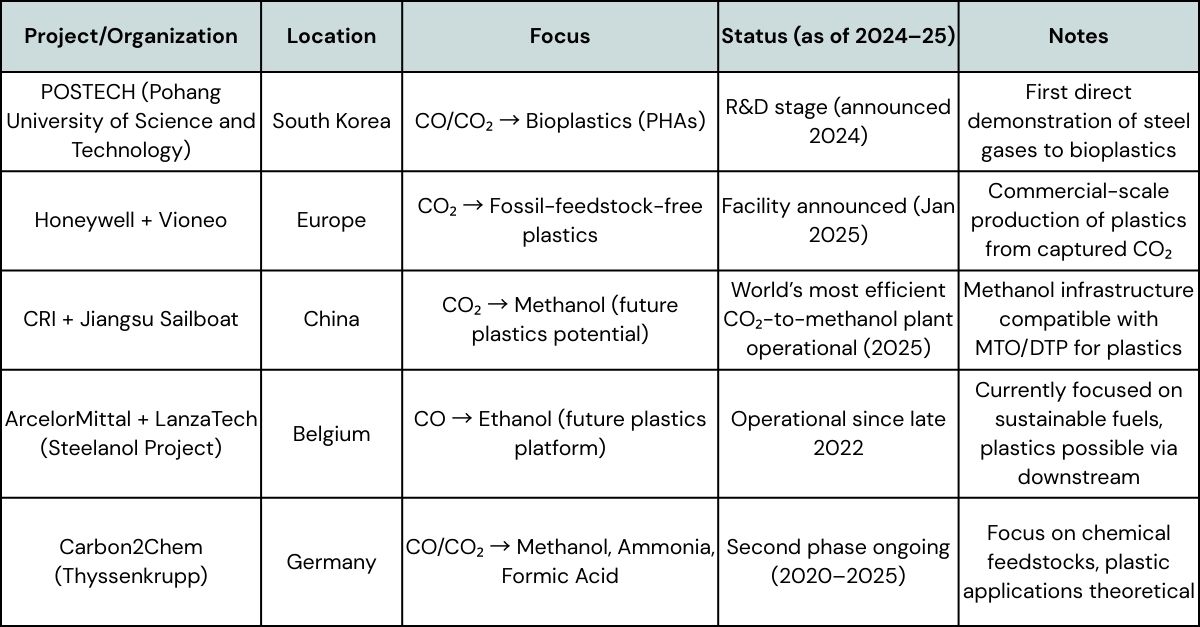
While the concept of transforming industrial off-gases, especially carbon monoxide (CO) and carbon dioxide (CO₂), into valuable chemicals has been under exploration for years, recent advances are spurring the shift from research to commercial and pilot-scale deployments. Across sectors, companies and research institutions are using emissions not just from steelmaking but from broader industrial sources to produce methanol, bioplastics, and even fossil-free polymers. These projects shows how carbon-rich by-product gases, once considered waste, are being reimagined as strategic inputs for circular production models, especially in plastics.
At the same time, Honeywell and Vioneo revealed plans in early 2025 to build a facility in Europe using Honeywell’s proprietary carbon capture and utilization (CCU) technology. This facility will produce fossil-feedstock-free plastics from captured CO₂, offering a commercial-scale example of circular carbon valorization directly into polymer value chains.
In China, a notable milestone was realized. A collaboration happened between Carbon Recycling International (CRI) and Jiangsu Sailboat. They launched the world’s most efficient CO₂-to-methanol plant in 2025. Although current outputs are focused mainly on fuels and chemicals, the infrastructure is quite compatible with methanol-to-olefins (MTO) and Direct-to-Propylene (DTP) technologies. This could open avenues for future integration into plastics production.
Also, CRI’s SAILBOAT project, started in 2024, intends the industrial-scale transformation of CO₂ emissions into high-purity methanol. Further, this could fortify the potential for plastics feedstock generation under expanded deployment cases.
In South Korea, researchers at POSTECH (Pohang University of Science and Technology) announced a breakthrough in 2024. They successfully converted steel mill off-gases, especially carbon monoxide and carbon dioxide, into bioplastics such as polyhydroxyalkanoates (PHAs). This advancement demonstrates the direct transformation of industrial emissions into biodegradable polymers, creating a promising link between steelmaking and sustainable plastics.
Earlier expeditions have also played a key role in laying technical foundations. ArcelorMittal’s Steelanol project in Belgium, developed in collaboration with LanzaTech, began operations in 2022. They converted steel mill gases into ethanol through gas fermentation. The focus right now remains on sustainable fuels and base chemicals. But ethanol could definitely serve as a platform for future plastics production via chemical upgrading. Similarly, Germany’s Carbon2Chem project, launched in 2016 and currently in its second phase (2020–2025), demonstrated the conversion of blast furnace gases into methanol, ammonia, and formic acid. The project has not yet prioritized plastics production. But it has shown critical aspects of industrial carbon valorization that newer initiatives are now expanding upon.
Together, these efforts highlight a clear shift: industrial emissions, once treated as waste, are majorly being reimagined as strategic feedstocks. This trend is set to spur as regulatory frameworks change and circular economy principles reshape industrial production models.
The Technology Behind the Transformation
The successful conversion of steel by-product gases into plastics highly depends on advanced chemical technologies. One of the most established methods is methanol synthesis. It is carried on through catalytic hydrogenation of CO and CO₂, often with the help of copper-based catalysts. Once methanol is produced, it presents as a versatile platform molecule. It can be converted into olefins, primarily ethylene and propylene. This is done through processes such as Methanol-to-Olefins (MTO) as well as Direct-to-Propylene (DTP).
The DTP process, especially , is notable for its potential to simplify the production chain and reduce by-products compared to traditional MTO. From these olefins, standard polymerization techniques can produce widely used plastics such as polypropylene and polyethylene.
Alternatively, gas fermentation technologies (like those used by LanzaTech) rely on microbes to digest CO or CO₂ and produce alcohols such as ethanol. These can also act as intermediates for plastic production. But this needs additional chemical transformation steps and is not the current focus of fermentation-based systems.
Sustainability and Economic Upside
Amidst these great developments, there is a drive to lower the carbon intensity of plastic production. These projects opens up a path to possible life-cycle greenhouse gas reductions. How? By phasing away slowly from fossil-derived naphtha or natural gas feedstocks and rather making use of carbon that would else be emitted into the atmosphere.
The economics are also evolving. As carbon pricing schemes expand and intensify, the cost of emitting CO₂ is becoming a financial burden. By turning emissions into a feedstock for valuable materials, companies can lower compliance costs and open new revenue paths. Also, using domestically captured emissions to produce base chemicals improves supply chain resilience and reduces dependence on volatile fossil fuel markets.
Challenges Ahead
Despite the potential, the path to widespread adoption is not without hurdles. Scaling these technologies from demonstration to commercial scale needs considerable capital investment. Ensuring a steady and sufficiently pure supply of CO, CO₂ from steel mills adds to operational complexity. Regulatory frameworks for carbon utilization (CCU) are also underdeveloped compared to carbon capture and storage (CCS). This complicates accounting for emissions reductions.
Also, while technologies like MTO and DTP are commercially proven in other contexts, their integration into steel-gas-based systems is still fresh and new. Yield optimization, catalyst stability, and lifecycle economics all need careful evaluation before these systems can run at a notable scale.
Future Outlook
The idea of turning steel by-product gases into plastic feedstocks is gaining momentum but remains in a transitional phase. Projects like the one in Japan may lay the pathway for broader commercialization by validating the technical and economic feasibility of such integrations.
As regulatory and market pressures on carbon emissions grow along with circular economy principles becoming embedded in corporate strategies, interest in these pathways is likely to increase. But success will depend on technology as well as on inter-industry cooperation, policy alignment, and infrastructure development.
The transformation of steel by-product gases into useful plastics and polymers represents a compelling example of industrial symbiosis, turning one sector’s emissions into another’s inputs. While early in its commercial journey, this scenario offers a substantial route to reducing emissions without sacrificing material output. With strategic collaboration and continued innovation, carbon recycling may yet become a foundational element of both steelmaking and plastics production in a carbon-constrained world.