Since the wave of European chemical plant closures highlighted earlier in 2025, the specialty chemicals sector has hit a new phase. It is no longer only about contraction but about structural rebalancing. While production capacity continues to fall, companies and policymakers are now shaping what could become a leaner but more focused European chemical base.
New Closures and Strategic Shifts
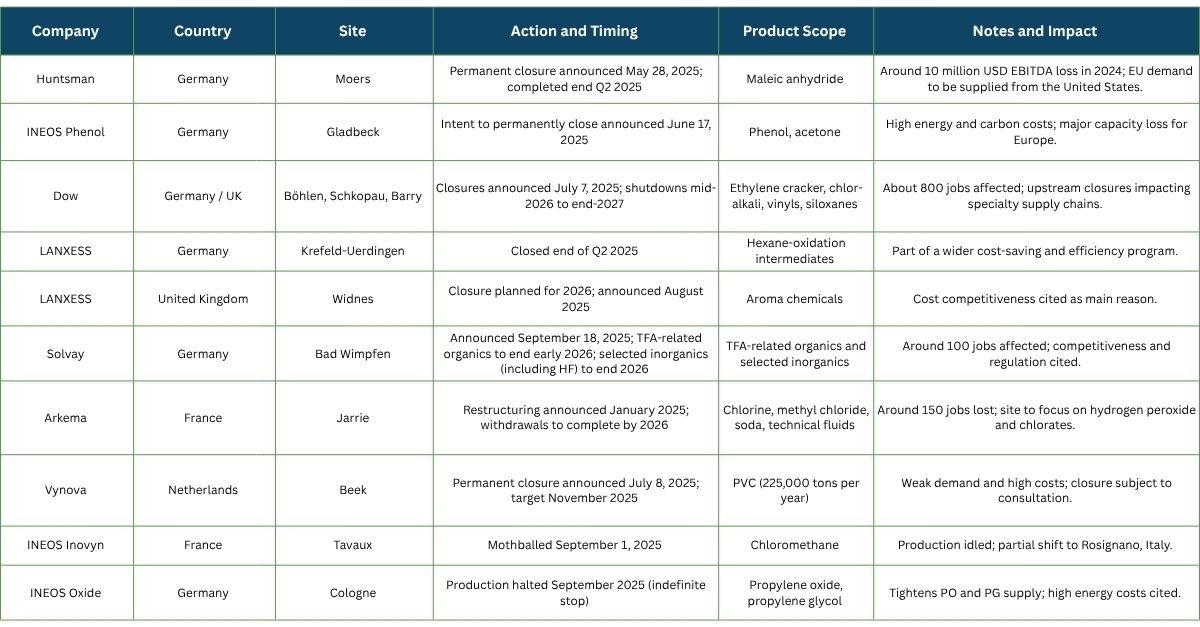
The list of closures and shutdowns has continued to grow through mid and late 2025. Huntsman completed the closure of its maleic anhydride unit at Moers, Germany, which was announced on May 28, 2025. The company cited persistent losses of around 10 million US dollars in 2024 and decided to consolidate production in North America.
INEOS Phenol announced on June 17, 2025, its intent to permanently close its large phenol and acetone site in Gladbeck, Germany, due to high energy and carbon costs. Dow disclosed a package of shutdowns on July 7, 2025, covering its ethylene cracker at Böhlen in Germany, chlor-alkali and vinyl assets at Schkopau, and the siloxanes plant in Barry, United Kingdom. These shutdowns will take place between mid-2026 and the end of 2027 and will affect about 800 jobs.
LANXESS completed the closure of its hexane-oxidation intermediates plant at Krefeld-Uerdingen, Germany, at the end of the second quarter of 2025. In August 2025, it announced plans to close its aroma chemicals plant in Widnes, United Kingdom, in 2026, citing poor cost competitiveness. Solvay announced on September 18, 2025, that it will stop producing TFA-related organic products at its Bad Wimpfen, Germany, site by early 2026 and will phase out selected inorganic products, including hydrogen fluoride, by the end of 2026. Around 100 jobs will be affected.
Arkema confirmed the restructuring of its Jarrie site in France, with production of chlorine, methyl chloride, soda, and technical fluids being withdrawn. This restructuring, announced in early 2025, will result in about 150 job losses.
Vynova announced on July 8, 2025, that it intends to stop producing PVC at its Beek, Netherlands, site by November 2025. The facility’s capacity is about 225,000 tons per year, and the company cited overcapacity and cost pressures. INEOS Inovyn mothballed chloromethane production at its Tavaux, France, site effective September 1, 2025, while shifting part of the production to Rosignano, Italy.
INEOS Oxide halted production of propylene oxide and propylene glycol at Cologne, Germany, in early September 2025. Industry reports described this as an indefinite stop resulting from high costs and weak demand. Apart from these large companies, industry observers have reported continued insolvencies among smaller firms in Italy, Switzerland, and Belgium, especially in the epoxy resin and fluorochemical segments, though individual company details are often not publicly disclosed.
Major Closures Announced or Completed
Supply Chain Adjustments
These closures are changing how supply chains operate in Europe. Industry reports suggest that pharmaceutical companies are increasingly sourcing intermediates from India, which is moving parts of the active pharmaceutical ingredient supply chain out of Europe.
Electronics producers are taking longer to qualify new Asian suppliers as they replace European ones for solvents and coatings. This has raised concerns about quality consistency as well as intellectual property protection. Automotive manufacturers are also looking for partnerships and joint ventures with chemical producers in Eastern Europe to reduce costs while keeping production relatively close to their factories.
Policy Developments and Government Actions
Late 2025 brought the first major European policy responses to these challenges. In July, the European Commission released the Chemicals Industry Action Plan. This included the creation of a Critical Chemicals Alliance to strengthen competitiveness and secure the supply of key chemical materials.
The Commission also said it intends to propose by the end of 2025 an expansion of the Carbon Border Adjustment Mechanism to include more chemical intermediates, along with measures to protect exporters against carbon-related trade disadvantages. The European Union imposed definitive anti-dumping duties on epoxy resins imported from China, Taiwan, and Thailand on July 25, 2025, following provisional duties set earlier in the year.
Germany also introduced a national relief program to lower electricity costs for industrial users. The program includes reductions in grid fees and electricity taxes for power-intensive industries such as fluorochemicals and solvents. These measures are expected to take effect mainly from 2026.
Outlook
The specialty chemicals sector in Europe is no longer in a simple phase of decline but is becoming more divided. Large multinational companies are shutting down uncompetitive plants but investing in smaller, high-value, and lower-carbon technologies. Small and medium-sized firms remain vulnerable, and their difficulties are making European supply chains more dependent on imports from Asia.
The next 18 months will be crucial. If European subsidy programs and industrial policy measures are implemented quickly, the region could retain a specialized, innovation-focused chemical industry. However, if delays continue, Europe risks becoming primarily a downstream customer rather than a key production hub in the global specialty chemicals sector.