Synthetic polymers dominate formulations, accounting for almost half of the market. They serve as film formers, emulsifiers, thickeners, stabilizers, moisturizers, and conditioners in personal care products. Due to the versatility and low cost of many synthetic polymers, formulators are constantly interested in using them. However, some of these polymers are controversial. One common polymer, PEG, for instance, is made by ethoxylation, which produces the carcinogenic byproduct 1,4-dioxane. Following regulatory releases and consumer demand for sustainable alternatives, the use of synthetic ingredients in personal care formulations has dramatically decreased.
Derived from silica, another widely used synthetic polymer is silicone. They are used in moisturizers, sunscreens, and makeup products. However, some of the derivatives of silica are synthetically produced to create the desired formulations that end up tampering with the ingredient’s native properties. For instance, D4, D5, and D6, also known as cycloxanes, are heavily limited to be used in personal care products because of their persistent and bioaccumulative properties.
Last year, the EU proposed a total ban on the use of synthetic polymers, like polyethylene and polypropylene, which are present in microplastics. Although the phase-out of these microplastics is obvious, formulators will need to find alternatives, so the full transition will take some time. However, it is evident that sustainable polymers are replacing the synthetic counterparts of well-known synthetic polymers. And the search for the right product has shaken up the entire industry.
Sustainable Polymers in Personal Care
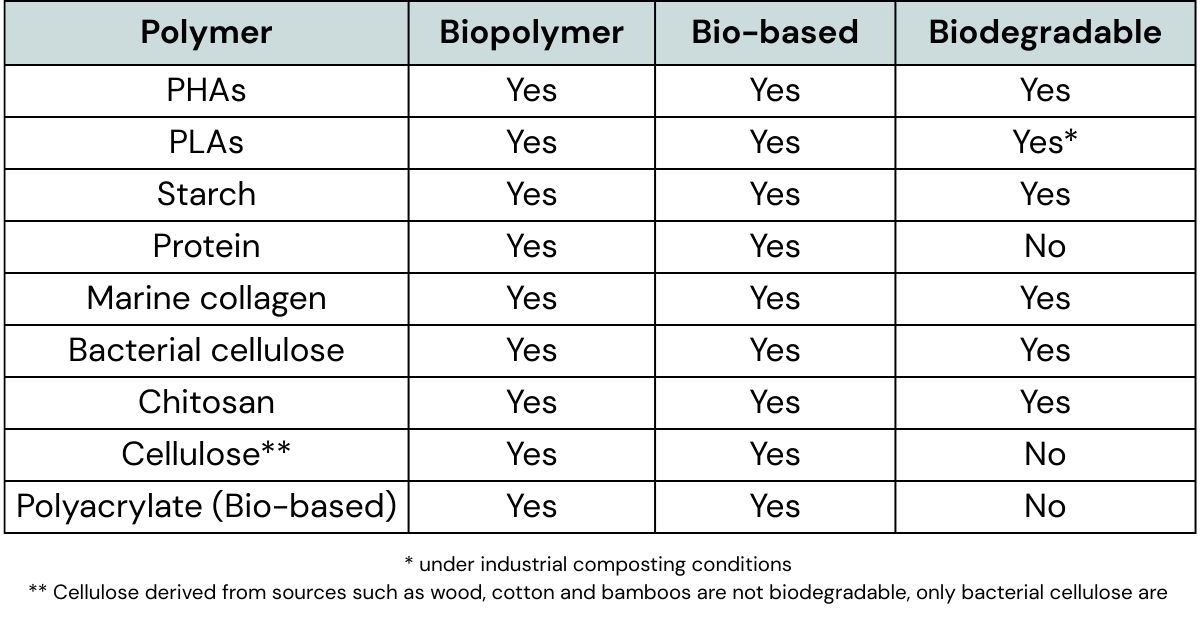
Proteins like collagen and polysaccharides, which are celluloses derived from plant cell walls, are examples of organic ingredients that are most frequently used to make them, though they can also be made from inorganic materials. Their functional qualities, like thickening, moisturizing, and skin regeneration, make them suitable for use in formulations. However, when formulators are selecting sustainable polymers, the fact that not all biopolymers are naturally biodegradable can be a significant differentiator.
Due to their natural origin, marine species are increasingly regarded as promising sources of sustainable polymers like collagen. Marine collagen is derived from two sources, vertebrates and invertebrates. The vast majority of marine species are invertebrates, which include crustaceans (mantis shrimp), mollusks (like Byssus and cephalopods), marine sponges, and echinoderms (starfish and sea urchins) as potential sources of collagen. However, the collagen content of vertebrates, such as finfish, is higher. This collagen is primarily found in the fish’s bones and skin and is most commonly used in personal care products because of its anti-aging, anti-wrinkle, wound-healing, and UV-protective qualities. It can be found in moisturizers, sunscreens, anti-aging creams, conditioners, and other products.
Both formulators and consumers prefer hydrolyzed collagen in vertebrates because it penetrates the skin more readily and has shorter peptide chains. Hydrolyzed collagen’s antioxidant potential, which comes from hydrophobic amino acids, helps to lessen oxidative stress, which causes aging.
Since marine collagen is made from fish scales, skins, and bones—a process that is in some ways a recycling of marine by-products—it is generally more sustainable than collagen derived from conventional sources (cows, pigs). Overall, the sourcing and use of fish by-products make marine collagen extraction sustainable, even though it typically uses cold extraction techniques, which are typically more energy-efficient than the high-heat rendering processes used in conventional land-based collagen production.
Bacterial cellulose is another biopolymer that can be referred to as the king of sustainable polymers because it is naturally biodegradable and bio-based, derived from specific bacteria, mainly from genera like Acetobacter, Gluconacetobacter, and Komagataeibacter, which produce cellulose as part of their metabolic processes. Bacterial cellulose is useful for skin care products like moisturizers and anti-aging treatments because of its high water retention and permeability. A bacterial cellulose mask, for instance, dramatically increased skin hydration by 76% in a study involving 69 volunteers over the course of two months, suggesting potential for skin treatments.
Chitosan, the second most abundant natural polymer after cellulose, is used extensively because it is skin-friendly and has a wide range of compatibility with other substances, including glucose, saccharose, starch, polyols, fats, oils, and acids. Chitosan is derived from chitin, a naturally occurring biopolymer that is present in the exoskeletons of insects, fungi, and crustaceans (such as shrimp and crabs). In addition to hydrating the skin, it has film-forming properties. The production of chitosan polymer necessitates procedures like deacetylation, which is a very gentle chemical treatment that does not require a lot of energy. This makes chitosan’s source and production sustainable.
Snail mucin is a common ingredient in Korean skincare products that can be used in place of film-forming and hydrating polymers like polyvinyl alcohol (PVA), polyethylene glycol (PEG), or carbomers. Because no animals are killed or harmed during the manufacturing process, its source and manufacturing are sustainable. The process involves encouraging the snails to secrete their mucus by stimulating them in order to collect mucin. After that, the mucus is removed and cleaned in preparation for its subsequent use in personal care products.
The Shift From Synthetic to Sustainable Polymers
However, the question is, in what situations is it practical and effective to substitute synthetic polymers?
Face and sheet masks are two common end applications. Bacterial cellulose and even biopolymers derived from algae can perform better than synthetic polymers in this particular application. Bacterial cellulose masks can stay hydrated for long periods of time because these polymers have a high water-holding capacity. Bacterial cellulose masks are also light and pleasant to the skin.
The introduction of hyaluronic acid into the market has already led to the replacement of synthetic polymers in moisturizers. Hyaluronic acid is now present in practically all moisturizers, which is a bio-based (microbial fermentation) ingredient and a natural film former that delivers the same properties as synthetic polymers but is more compatible with the skin. The added benefit is that it’s biodegradable.
In terms of cost comparison, one of the primary reasons why sustainable polymers are not being adopted more quickly than formulators is their high manufacturing costs. Natural ingredients are more expensive than synthetic ones, but they are necessary for sustainable formulations because their cultivation, extraction, and refinement require more work and energy. The extraction and refining of natural ingredients is more complex than synthetic ingredients, unlike synthetic ingredients, which are made in controlled lab environments and are very easy and convenient.
Sustainable polymers making waves in the personal care industry
Last year, IFF (International Flavors & Fragrances) collaborated with Kemira to develop renewable polymers derived from plant sugars using a technology called Designed Enzymatic Biomaterials (DEB). Recently, the company has completed the construction of its new plant in Finland, which produces renewable polymers using IFF’s Designed Enzymatic Biomaterial (DEBTM) technology. Enzymes used in this technology help in efficient polymer synthesis, which leads to lower energy consumption and waste generation.
Nouryon has launched Structure® Silk Starch, a new biodegradable ingredient for personal care products that is derived from renewable plant sources such as corn and tapioca. This is readily biodegradable according to OECD 301B1 standards and can be used as a replacement for synthetic polymers as it offers similar properties such as thickening, emulsion stability, film-forming ability, etc.
Earlier this year, Lygos, Inc. introduced Soltellus, a new line of sustainable polymers for hair and skin care products, and soon after this, Lygos and CJ BIO signed a memorandum of understanding (MOU) to produce commercial volumes of sustainable products, including polymers. Lygos plans to develop a commercial-scale biorefinery complex in Fort Dodge, Iowa, which will support the commercialization of Lygos’ flagship Soltellus™ biodegradable polymers. This polymer is produced through a fermentation process that utilizes renewable plant-based feedstocks (plant-derived sugars).
Lubrizol Life Science Beauty (LLS Beauty) has launched a new ingredient called Sensomer™ Tara polymer, which is derived from the endosperm of the Tara plant. It functions as a natural thickener and film former for personal care products.
Symrise has developed a new ingredient called SymFeel Quat Green®. This ingredient is derived from white sugar beet molasses, a by-product of the sugar industry, and is designed to replace synthetic polymers such as Polyquaternium 7 (PQ-7) and Polyquaternium 10 (PQ-10) in shampoos and conditioners.
Mitsubishi Corporation Life Sciences has developed Gluca Moist, which is made from torula yeast, a type of yeast often used in flavoring foods. What is interesting is that it is an alternative to sodium hyaluronate, which is a synthetic polymer. It promotes a circular economy by utilizing leftover yeast cells that are typically wasted after the flavoring process.
The market is being shaken by a new trend of using recycled materials in polymer formulations. For instance, Lamberti has created a new polymer called Esaflor® T that is made from recycled tamarind seeds. Active Concepts introduced AC Pina Colloida, a novel biopolymer that can be used in skin and hair care products. This innovative ingredient is known for being made from upcycled pineapple leaves. The main raw material is the high-cellulose fiber found in pineapple leaves.
Future Outlook
Sustainable polymers like PHA have the potential to surpass synthetic polymers as they provide matchable performance. They are also biobased and biodegradable. Their capacity to create a water-retaining, breathable film makes them adaptable to a wide range of personal care uses. Some biopolymers, like cellulose and starch, are often used in limited applications, like cellulose in face masks or starch in hair products, but they are not as versatile as PHAs. PHAs are regarded as the least hazardous biopolymers. However, other biopolymers, like PLA, which is made from corn or sugarcane, require energy-intensive processes like high-temperature polymerization.
This transition from synthetic to biopolymers is causing the demand for synthetic polymers to decline; silicone and other synthetic polymers may still be prevalent in the personal care market, but sustainable polymers are expected to become widely used.