When we talk about global plastic consumption, it comes down to approximately 520 million metric tons. No doubt, plastics have become an inseparable part of today’s society. This increment in the demand and production of plastic comes with an equal and shared responsibility for plastic waste management. Traditional disposal methods, such as landfilling and incineration, have several environmental risks, and this makes it imperative for us to switch to sustainable recycling solutions. That is why, today, governments and industry leaders are switching towards approaches that will likely lessen the burden of plastic pollution through advanced recycling technologies.
In the European Union, the Circular Economy Action Plan and the Single-Use Plastics Directive are influencing the adoption of innovative recycling technologies. These regulations promote the use of recycled content across industries, with a strong emphasis on packaging, while also encouraging its application in sectors such as automotive, construction, and consumer goods. In the United States, several states are implementing Extended Producer Responsibility (EPR) programs, and major corporations are pledging to incorporate higher levels of recycled content in their packaging. In Asia, China’s plastic waste import ban has prompted a renewed focus on domestic recycling. China’s plastic waste import ban has created opportunities for India and Indonesia to strengthen their domestic recycling industries and attract investments in waste management and circular economy solutions. With stricter regulations like India’s EPR policies and Indonesia’s plastic waste reduction targets, both countries can position themselves as regional recycling hubs. But there could be a risk of illegal dumping of plastic waste and environmental challenges in the absence of required infrastructure and proper enforcement of regulations. This may reduce the potential benefits of this shift.
As plastics are versatile, cost-effective, and widely applicable in various industries, their demand continues to grow exponentially. There is no doubt that plastics have many advantages, yet managing plastic waste is still a major global concern. This is because only a fragment of plastic is recycled effectively. Current estimates project that global plastic consumption will reach nearly 590 million metric tons by 2028, yet recycling rates lag due to challenges in waste collection, sorting inefficiencies, and contamination. Although Europe has a mismanagement rate of 3% that is collectively lower than other regions because they have a well-established collection system that involves key stakeholders in the entire value chain. Mismanagement is relatively higher in the Asia-Pacific (excluding South Korea and Japan) region due to the inefficient collection system and unorganised structure in the recycling industry. As there is a rise in environmental awareness in society and regulatory pressures for producers, industries want to improve their recycling technologies and sustainability initiatives.
Industry-Wise Plastic Consumption and Waste Generation
The plastic waste crisis varies across industries, with some sectors contributing more significantly to the problem than others. Packaging tops the plastic consumption as it accounts for nearly 40% of the global demand. This leads to excessive waste generation because most packaging materials are single-use. The building and construction industry also depend on plastic for insulation, pipes, and fittings. Though these materials have a longer lifespan than packaging waste, building and construction generate around 30 to 35% of plastic waste. The textile industry, particularly synthetic fibre production, contributes to plastic pollution through non-biodegradable materials such as polyester. Also, the automotive and electronics industries make use of high-performance plastics. This presents unique recycling challenges because of their complex material compositions.
The plastic waste management market is experiencing steady growth, with a projected compound annual growth rate (CAGR) of approximately 4.1% from 2022 to 2028. Rising regulatory mandates, technological advancements in recycling, and growing consumer awareness about environmental concerns compel this expansion. The plastic recycling performance varies widely among different geographic zones because each region creates unique policies and investments in infrastructure along with divergent levels of public participation. Germany manages to recycle 52% of its plastic waste because of its robust waste sorting infrastructure and its sturdy government rules. France exhibits improvements yet remains behind other countries as its plastic recycling stands at about 29% of total use. The Indian recycling rate surpasses other regions at 60% because of its downcycling trend. Also, local recyclers participate together with major companies while the government supports plastic waste management through the “Plastic Waste Management Act”. China banned overseas plastic waste imports so the country seeks to establish native recycling facilities while maintaining a 34% recycling rate. The recycling rate in Indonesia is at 13% but the country is boosting financial investments to fight environmental deterioration through plastic waste management and recycling.
Materials and Polymers Recovery Through Recycling Technologies
The most common method is still mechanical recycling, which includes sorting, cleaning, shredding, and repurposing plastic waste to create new goods. Polyolefins like polyethylene (PE) and polypropylene (PP) constitute some of the most frequently recycled polymers. Generally, these are utilised in packing. Polyethylene terephthalate (PET), which is commonly found in beverage bottles, has an efficient recycling stream. Multi-layer films, usually used in food packaging, pose challenges because of their complex structure and also require advanced separation technologies.
Governments throughout the world are enacting strict laws to enhance the management of plastic waste and support efforts for the circular economy. Extended Producer Responsibility, or EPR programs, are increasingly playing a distinguished role in holding producers accountable for the handling of their plastic products’ end-of-life. An increase in investment in recycling infrastructure and advanced technologies, such as dissolution-based recycling, is promising as a result of this shift.
Dissolution-based recycling is a newer approach as compared to mechanical recycling. This method of physical separation preserves the molecular integrity of particular polymers by dissolving them selectively and removing them from contaminated or multilayered waste streams. In this procedure, target polymers are selectively dissolved utilizing solvents. Dissolution-based recycling maintains the original properties of plastics when compared to chemical recycling methods such as pyrolysis or depolymerization, which break the polymers into monomers. This makes it significantly helpful for sectors like electronics, textiles, and packaging that need high-performance recycled materials. This process is carried through a variety of solvent types, such as organic and ionic liquids. This technique extends a practical way to recycle plastics that are typically regarded as non-recyclable, like waste streams that are mixed and highly polluted.
Because various polymers need different solvents for effective separation, solvent selection becomes important in dissolution-based recycling. Depending on the type of polymer, the degree of contamination, and the processing conditions, different solvents are utilized. This selection process involves a number of essential factors, including the solvent’s selectivity, the chemical structure of the polymer, and environmental factors.
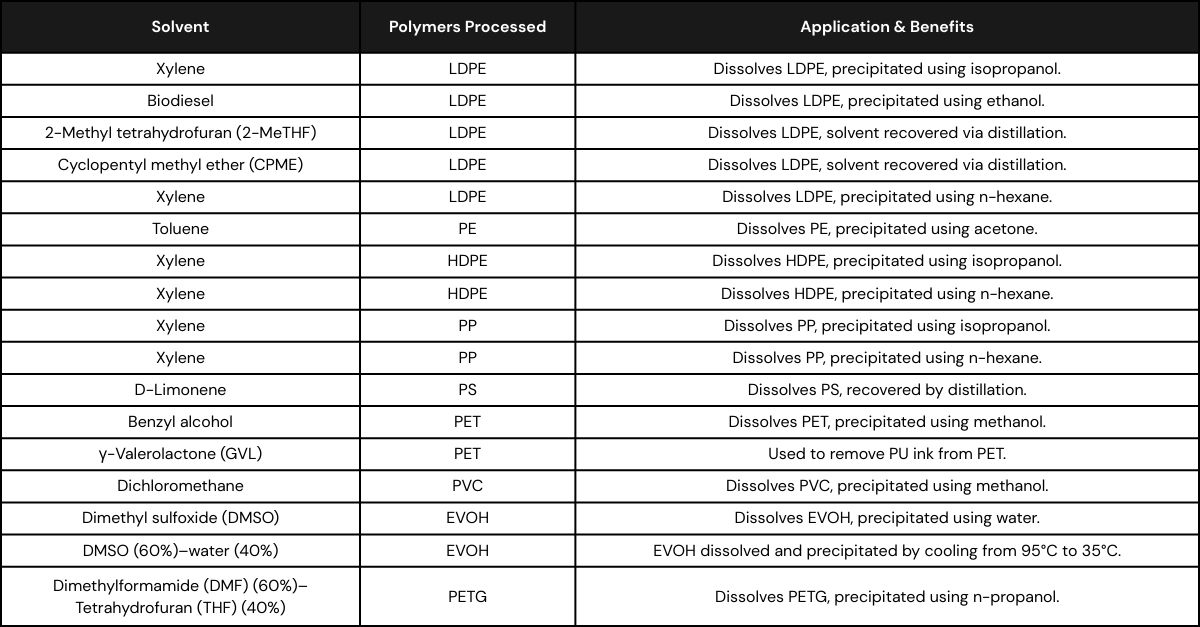
Industry stakeholders are optimizing solvent recovery systems to increase efficiency and maintain compliance with international environmental and regulatory standards, such as the US EPA Sustainable Materials Management (SMM) framework and the EU Green Deal Circular Economy Plan, due to their ongoing advancements in these technologies.
Industry Insights
In October 2024, LyondellBasell acquired full ownership of Germany-based APK AG to integrate and scale APK’s solvent-based recycling technology for low-density polyethylene (LDPE). This move aims to enhance the recycling of flexible packaging materials by producing high-purity LDPE suitable for applications like personal care product packaging. In April 2024, Dow and Procter & Gamble announced a partnership to develop dissolution technology to recycle rigid, flexible, and multilayer plastic packaging. The goal is to transform these materials into recycled polyethylene for use in P&G’s packaging, addressing the challenges of mixed plastic waste streams.
In July 2024, Trinseo was granted a patent for its dissolution-based polymer recycling technology, enabling the selective recovery of high-quality polymers from complex waste streams. This innovation is particularly valuable in industries such as automotive, electronics, and toys, where mixed plastics present recycling challenges. Trinseo’s method supports the development of more sustainable, high-performance materials for industrial applications. In 2024, Braskem entered into a strategic partnership with TNO to enhance the dissolution-based recycling of polyolefin residues. The collaboration aims to develop sustainable methods for recovering polyolefins (PP, PE) from post-consumer waste, reducing the environmental footprint of plastic packaging and automotive components. Braskem is working towards scalable, energy-efficient circular solutions by integrating dissolution-based techniques with mechanical recycling.
Wrapping Up
Both physical and chemical recycling techniques are the way of the future for plastic waste management. In the next 5 to 10 years, dissolution-based recycling is poised to develop significantly due to corporate sustainability pledges, technological advancements, and regulatory changes. Even if there are issues with solvent recovery and cost-effectiveness, continued research and industry partnerships will enhance this method’s scalability and efficiency. Dissolution-based recycling will become important as the world’s need for high-quality recycled materials grows and plastics move toward a sustainable circular economy.
This article was originally published in Sustainable Plastics.