Dietary fiber is a well-known human health nutrient
that consists of both insoluble and soluble fiber. Unlike insoluble fibers,
soluble dietary fibers are easily absorbed and digested by fiber-degrading
bacteria in the human colon. This results in the production of a wide range of
beneficial and functional metabolites. Soluble fibers are an essential
component in infant formula because they have a significant impact on the
microbial composition and metabolic activity of an infant’s gut. The first few
months of life are particularly vulnerable to microbial infection. The various
stages of microbiome formation provide critical windows and opportunities for
long-term health in terms of immunological and metabolic development.
Dietary fibers in
infant formula
The infant milk formulation available on the market
lacked an essential component, Human Milk Oligosaccharides (HMOs), the
prebiotic components found in human breast milk. They are a type of soluble
fiber that helps infants develop their gut microflora and immune system.
However, industrial production of HMOs was limited due to structural complexity,
increased production costs, and regulatory barriers, among other factors.
In recent years, technological advancements have
resulted in the production of three non-human milk soluble fibers: two
oligosaccharides, primarily fructooligosaccharides (FOS) and
galactooligosaccharides (GOS), and one polysaccharide inulin, which is used as
an alternative supplement to infant formula.
In addition to inulin, FOS, and GOS, other fibers
such as polydextrose and corn fiber are being used in baby food, but their penetration
is currently low (<1%). Polydextrose has a chemically synthesized image, and
people are attempting to ban it from the food industry, with Europe leading the
way. Corn soluble fiber is common in other foods, but not specifically in baby
food. While corn allergies are less common, there may be GMO concerns, leading
to a preference for alternative fiber sources. There have also been more
scientific studies and strict regulations on inulin, FOS, and GOS. This makes
them a viable option, especially in the baby food segment, which is closely
monitored and regulated by government bodies.
Manufacturers (Nestle, Danone, Mead Johnson,
Nutricia, and Wyeth Nutritionals) have attempted to incorporate these soluble
fibers into infant formula products in order to mimic the properties of HMOs
found in breast milk and provide effects similar to the diversity of the infant
gut microbiota. These commercially available soluble
fibers can be added alone or in combination of different ratios, depending on
the composition of the infant formula.
The market for soluble fiber in food and beverage
applications was estimated to be worth more than $5 billion by 2022, with
infant food being one of the most important applications. The global soluble
market for baby food is approximately $0.5 billion, with over 60% of products
containing added fiber.
The global market for inulin, FOS, and GOS in baby
food was estimated to be around $0.4 billion. The penetration rate for FOS and
GOS is more than 30%, whereas for inulin it is ~10-20%. In some compositions,
these dietary fibers are present together or separately, depending on the
target composition.
HMO regulations,
partnerships, and more
The regulations in the baby food segment have been
quite stringent over the years, with companies such as Abbott recalling
multiple stocks due to contamination back in 2022. However, with time and
improved technology, the tide is gradually shifting.
Danone was the first company to receive regulatory
approval for HMOs in Europe a few years ago. Many companies, including Chr.
Hansen, have now received approval to use HMO in baby milk. The United States
was the second major economy to approve the use of HMOs in baby food
formulations shortly after. However, there have recently been multiple reports
that companies (dsm-firmenich, IFF, and Mengnui) have received approval to use
their HMOs in the Chinese market. Asia-Pacific is one of the leading segments
for infant food. Thus, this move has the potential to alter the trajectory of
HMO’s entry into the baby food market, gradually replacing other commonly used
soluble fibers.
Nestle, on the other hand, closed its Irish factory,
which supplied infant formula to Asian markets, particularly Greater China.
This was due to low birth rates and the locals’ reliance on regional brands of
infant formula. The shifting preferences and dominance of local businesses
threw the overall picture into disarray. However, even though competition has
become fierce, it is fair to say that HMO’s market relevance has increased
significantly. Notable local infant formula producers, including Feihe/Firmus,
Shijiazhuang Junlebao Dairy, Yili, and Bright Dairy, have grown in recent
years. This shift could also be attributed to government regulations aimed at
addressing the “grey market” scenario and providing additional
support to local producers.
Market Penetration: HMO
v/s Inulin, FOS and GOS
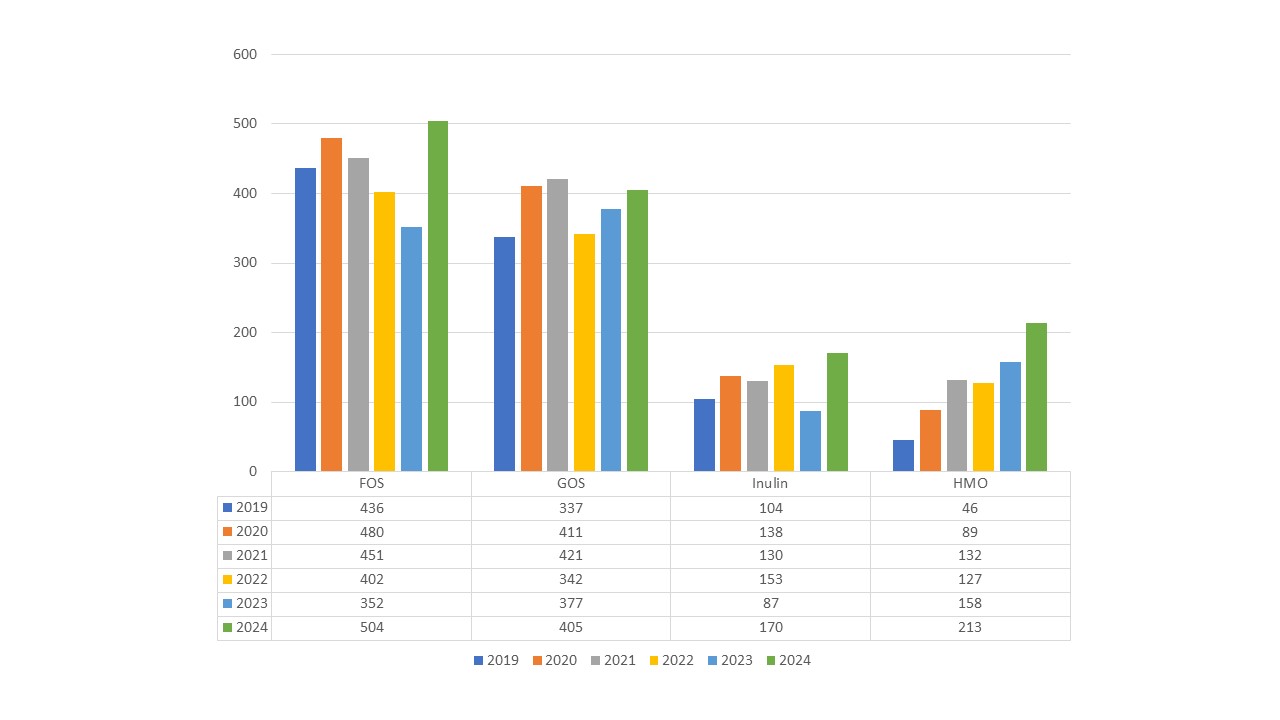
Year after year, the number of HMO-based
product launches has steadily increased. On the other hand, the use of inulin,
FOS, and GOS has fluctuated. There have been fewer product launches for inulin,
FOS, and GOS. The number of HMO-based product launches has increased by ~17% in
the last year while the use of FOS, and inulin has decreased by 12% and 40% in
the same period, respectively. However, product launches in GOS haven’t
decreased but rather increased by 10%. From 2024, the product launches
containing HMO, FOS, and inulin have increased and GOS have remained constant.
When it comes to fully transitioning from inulin,
FOS, and GOS to HMO, the idea is a little far-fetched. The price parity for the
products will take some time to close, as HMO falls into the premium category.
Based on our market research, baby food containing HMO is typically over 50%
more expensive than products containing fibers like inulin, FOS, or GOS. The
market has a good mix of FOS and HMO-based products, including Nestle,
Nutricia, Abbott, and Nestle. Some companies, such as Abbott Laboratories
(Ireland, Spain, and the United States), Wyeth Nutritionals (Singapore and
Ireland), Namyang Dairy Products (South Korea), FrieslandCampina (Netherlands),
and Mead Johnson Nutrition (Thailand), have increased the number of product
releases. [1]
However, as HMO production methods become more
cost-effective, prices may be controlled over time.
Future Outlook
Earlier this year, the Human Milk Institute (HMI),
based at the University of California, received funding from Novonesis to
establish a research consortium to accelerate innovation and delivery in HMO
science. Based on current trends, HMOs will undoubtedly have a significant
market presence in the future. However, closing the price gap and timely
government regulations are the only two factors that can increase its market
availability and acceptance.
Note: [1] Names in the brackets indicate
launches by companies in that region.
***
This article was originally published in Nutraceutical Business Review.