From neon-lit labs in Riyadh to rooftop farms in Abu Dhabi, the GCC is morphing into a living testbed for food’s next frontier, where yogurt meets IoT, additives get the green light, and protein growers outnumber oil rigs. As global appetites shift toward climate‑smart nutrition and supply‑chain shocks become table stakes, these nations aren’t just supplying ingredients, they’re scripting the recipe for tomorrow’s plate.
Driven by rising incomes, population growth, and urbanization, food consumption in the GCC is projected to grow at a compound annual growth rate of 2.8% to 56.2 million tonnes by 2027. Concurrently, Saudi Arabia’s food manufacturing sector is set to attract over USD 70 billion in investments by 2030, underscoring the Kingdom’s ambition to bolster domestic production.
Over the past three years, the GCC has seen a marked plateau in per capita food spending. However, the consumption mix is shifting from bulk staples to value-added, healthier, and convenience-oriented food formats. Between 2022 and 2025, categories such as ready-to-drink beverages, functional snacks, and plant-based dairy alternatives have outpaced traditional growth segments.
This shifting demand is being matched by supply-side momentum. From smart dairy systems to precision-engineered starches and locally scaled protein production, the six GCC nations, the United Arab Emirates, Saudi Arabia, Qatar, Kuwait, Oman, and Bahrain, are evolving into regional powerhouses in food manufacturing and ingredient innovation.
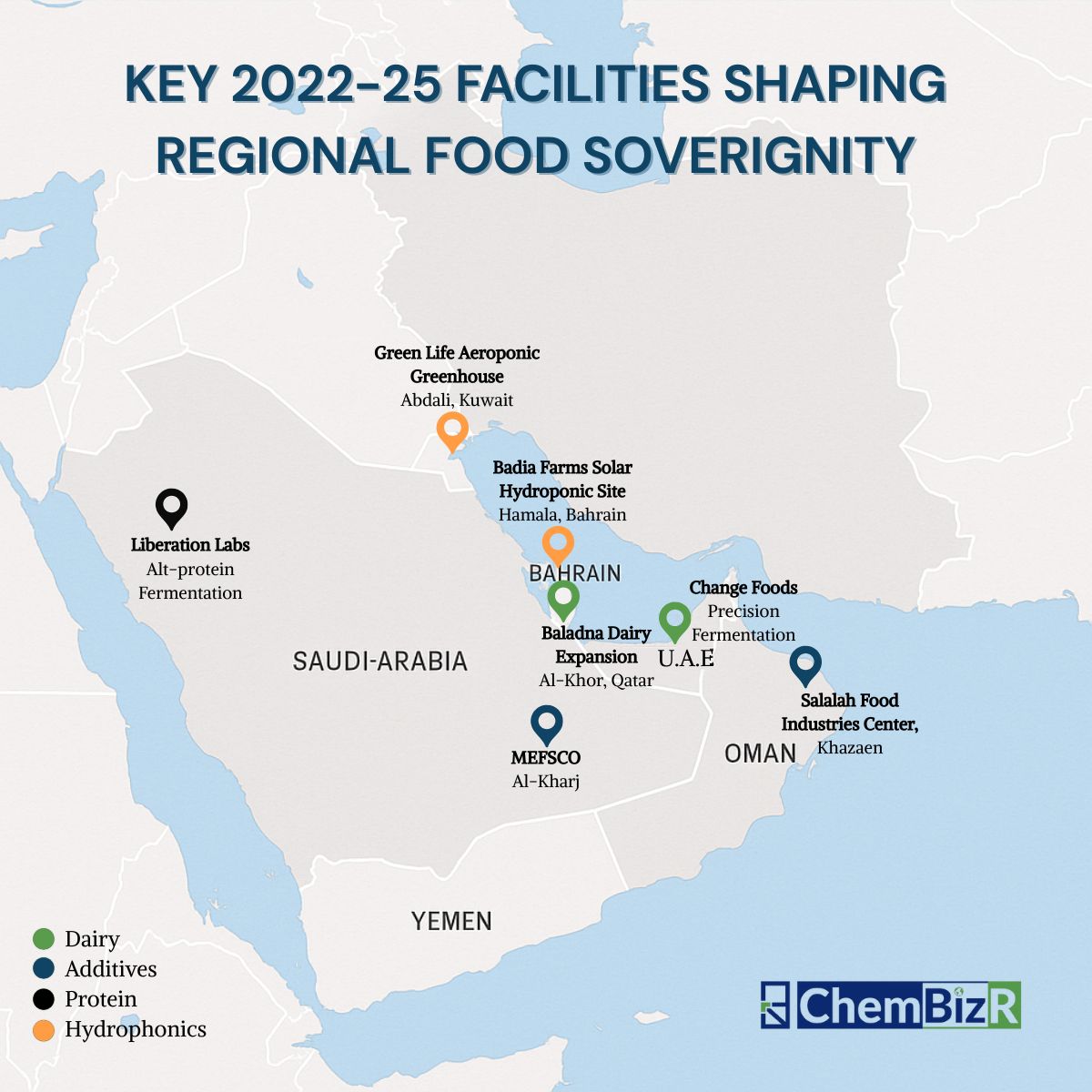
In Kuwait, Green Life Company has introduced a 24,000 m² aeroponic greenhouse in Abdali powered by CleanGreens technology, cultivating high-yield leafy greens with minimal water input. Meanwhile, the UAE is scaling climate-aligned dairy innovation, with Change Foods establishing a precision fermentation facility in Abu Dhabi’s KIZAD to produce 1.2 million liters of animal-free casein annually, reinforcing the region’s shift toward biotech-enabled, locally produced food ingredients.
At the heart of this shift lies a triad of priorities: reducing dependency on imports, safeguarding food security, and driving economic diversification through local value chains. This transformation is driven by strategic government policy, sovereign-backed investment, and partnerships with leading food-tech firms. Precision-fermented dairy and additive-free organic products are scaling under initiatives like the NextGen FDI program in the UAE. Saudi Arabia is witnessing landmark developments such as the region’s largest glucose and starch processing plant, while embracing alternative proteins to support aquaculture and Vision 2030 objectives. Qatar continues to push boundaries in dairy protein innovation and is pioneering regulatory pathways for cultivated meat.
Kuwait and Oman are expanding domestic starch and flour processing capabilities, with Kuwait’s novel plant-based cheese starches and Oman’s sugar refinery and food industrial zones playing central roles in food self-sufficiency. Bahrain, though smaller in industrial capacity, is strengthening its niche in clean-label dairy and local ingredient sourcing through targeted agricultural initiatives.
Innovation and Technology Adoption
Technological adoption is central to the GCC’s strategy for overcoming water scarcity, extreme heat, and limited arable land. Governments and private players have accelerated investments in hydroponics, vertical farming, and controlled‑environment agriculture (CEA), leveraging AI and IoT for precise resource management. The UAE’s National Strategy for Food Security includes a program of 38 initiatives, among them the ‘National Farms Sustainability Initiative’ secures purchase agreements to raise government procurement of domestic produce to 70% by 2025 and 100% by 2030. Similarly, Qatar’s forthcoming National Food Security Strategy (2023–2030) will expand CEA pilot projects to achieve over 50% self‑sufficiency in key vegetables and dairy.
In August 2024, Al Ghurair Foods also inaugurated a corn starch plant at KEZAD – the first in the region. This “state-of-the-art” facility will locally produce refined starch (a first-of-its-kind in MENA) to support UAE food manufacturing.
Yet the transformation extends well beyond the farm. Across the GCC, food manufacturers and logistics players are digitizing operations to close gaps in resilience, traceability, and sustainability. Almarai, the region’s dairy heavyweight, is integrating AI-powered route optimization and dynamic fleet analytics to strengthen cold-chain reliability across the Kingdom. The National Food Products Company (NFPC) has converted its KEZAD facility into a full-fledged smart dairy plant, where IoT sensors continuously monitor and auto-adjust fermentation parameters for yogurt production, signaling a move from manual oversight to machine-assisted precision. Abu Dhabi’s Agthia Group rolled out new specialty flours and dairy premix ingredients. In 2024, Agthia introduced a range of high-performance flour (starch) products and an “Agrivita Dairy Premix” (an additive for yogurt and juices) to meet evolving customer needs. Agthia’s innovation pipeline also includes IQF (flash-frozen) fruit lines and expanded frozen‑potato products for its Nabil brand.
Meanwhile, automated warehousing, robotic handling systems, and blockchain-backed traceability are becoming foundational elements in food logistics. From Salalah Free Zone in Oman to King Abdullah Port in Saudi Arabia, investment is ramping up in temperature-controlled robotics and digital inventory systems to enhance regional food transport. These innovations are especially for high-risk perishables, improving both safety assurance and shelf-life extension.
Governments are nurturing this transition not only through policy but also through capital: the UAE’s Food Tech Valley, developed with Wasl Properties and the Ministry of Climate Change and Environment, is funding startups working on smart irrigation, circular aquaponics, and food waste valorization. In Saudi Arabia, King Abdullah University of Science and Technology (KAUST) is spearheading advanced R&D on salinity-tolerant crop genes and regenerative desert agriculture, with deployment linkages to strategic areas like NEOM.
Industry-wide acceleration is being catalyzed by regional platforms like Gulfood 2025, which hosts over 5,500 exhibitors from 129 countries, and Saudi Arabia’s InFlavour Expo, engaging 400 global brands to drive investment in sustainable food and ingredient innovation.
Shift in Local Production and Import Dynamics
Historically, the GCC imported over 85% of its fruits and vegetables; in the UAE alone, 4.65 million MT (85% of F&V demand) were imported in 2022, with just 15% sourced locally, mostly dates and cucumbers. To reverse this, states have mobilized incentives,free‑zone food parks in the UAE, soft loans in Saudi Arabia, subsidized farm inputs in Kuwait, to spur local manufacturing units and agri‑parks. For instance, Saudi Arabia has tripled its overseas farmland investments since 2022, securing long‑term grain and feed supplies from Canada, Pakistan, and Sudan. Meanwhile, national champions like Almarai, Baladna, and Kuwait Dairy Company have scaled processing capacity, contracting local farms to increase fresh‑milk sourcing to over 75–96% of domestic demand.
The UAE is reinforcing local production under its National Food Security Strategy 2051. The Ministry of Climate Change & Environment (MOCCAE) launched the “Nemah” Farms Sustainability Initiative to boost domestic output of key foods. MOCCAE officials note that food security is a “national security issue” and are promoting advanced farming (organic, vertical, aquaculture) and guaranteed purchase agreements for local farms. These efforts – backed by FDI incentives like NextGen – aim to raise self‑sufficiency (e.g., targeted 50% local food production by 2051) and reduce reliance on imports.
Import‑diversification efforts include renegotiating trade agreements and establishing strategic reserves. Qatar’s Hassad Food has acquired stakes in dairy farms abroad, while Oman has launched a sugar refinery at Sohar Port to replace significant imports with domestic output. These moves not only reduce vulnerability to global price shocks but also generate region‑wide distribution hubs, leveraging Bahrain’s re‑export infrastructure and the UAE’s logistics prowess to distribute GCC‑produced food across MENA.
Policy Frameworks and Food Security Initiatives
Since 2022, GCC governments have enacted comprehensive food‑security blueprints. Saudi Arabia’s Vision 2030 Agricultural Cluster program earmarks SAR 94 billion (US$ 25.1 billion) in industrial investments to achieve 125% self‑sufficiency in dates and 87% in vegetables, supported by dam construction and desalination‑powered irrigation. The UAE’s 2051 strategy combines supply‑chain resilience, public awareness, and R&D funding to rank first globally on the Food Security Index by mid‑century. Kuwait’s 2022 National Strategy for Food Security encourages banks to finance farms, imposes import restrictions on sensitive staples, and forges GCC‑wide procurement pacts; Oman’s Vision 2040 and Food Security Laboratory promote high‑tech investments and a “Million Date Palm” program; Bahrain’s National Strategy caps non‑local imports and incentivizes banks to underwrite food‑security ventures.
These policy frameworks are bolstered by regional coordination via the Gulf Food Security Council, which maintains emergency reserves, harmonizes regulations, and arranges cross‑border logistical support. Such multilateral mechanisms have proven critical during price spikes and transport disruptions, enabling member states to pool resources and deploy rapid‑response distribution when global supply chains falter.
Supply‑Chain Transformation and Digitalization
The rapid rise of e‑commerce and quick‑commerce platforms has redefined last‑mile logistics in the GCC. Major retailers and foodservice operators have partnered with third‑party tech providers to deploy automated micro‑fulfillment centers, leveraging robotics and AI for order assembly and route optimization.
Blockchain pilots are underway to ensure traceability from farm to fork, addressing consumer demand for provenance and safety. In Saudi Arabia, a consortium of dairy producers is testing distributed‑ledger systems to record each stage of milk collection, processing, and distribution, reducing spoilage and enhancing recall efficiency. Meanwhile, cloud‑based analytics platforms are helping processors forecast demand, optimize SKU portfolios, and dynamically price fresh and value‑added products.
As digital transformation accelerates, GCC food players are forging partnerships with global tech firms and local startups, co‑developing tailored solutions for hot‑climate logistics, nutrient‑fortified packaging, and AI‑driven quality inspection. These innovations, coupled with government‑backed digital infrastructure upgrades, are establishing the GCC as a laboratory for next‑gen food‑supply‑chain architectures, setting a blueprint for resilient, efficient, and consumer‑centric ecosystems across the region.
Future Outlook and Strategic Implications
As the GCC continues to chart a course away from food import dependency, the region’s next phase of transformation will likely hinge on integration between localized production, smart manufacturing, and global collaboration. With precision fermentation in the UAE, aeroponic farming in Kuwait, and protein-focused clusters in Saudi Arabia, the foundation for a regional innovation network is already in place.
Looking ahead, the focus will shift from self-sufficiency to value creation, scaling high-margin exports in dairy ingredients, clean additives, and plant-based proteins. The collaboration between governments, industry leaders, and startups in this space will be instrumental in ensuring that the region remains resilient in the face of future disruptions, all while advancing a more sustainable and secure food future for generations to come.