The European chemical industry has long held a meaningful role in global markets, especially in the production and innovation of specialty chemicals used across pharmaceuticals, electronics, agriculture, and other high-tech industries. But between 2023 and 2025, the sector has seen a notable wave of chemical plant closures over several European countries. These shutdowns, both partial and complete, are more centered within the specialty chemicals segment, a sub-sector that, despite its smaller volume compared to commodity chemicals, holds distinct value because of its critical applications and technological complexity.
Drivers Behind the Closures
One of the leading causes of recent plant closures is the rise in energy costs. Europe’s dependence on fossil-based energy, especially natural gas for high-temperature processes in chemical manufacturing, has made the sector vulnerable to energy price volatility. The post-2022 energy crisis, added on to by geopolitical tensions and supply constraints, notably increased operational costs, impacting the economic viability of running specialty chemical plants in regions like Germany, Belgium, and France.
Environmental regulations have also raised cost pressures. Compliance with REACH (Registration, Evaluation, Authorization, and Restriction of Chemicals) has always been strict, but with the European Green Deal and aggressive net-zero emission targets, companies now face greater costs to overhaul facilities or switch to greener alternatives. For smaller players and even multinational operators, the investments needed to comply can outweigh potential profits.
Also, global economic dynamics play a role. Many specialty chemical producers are relocating or outsourcing production to areas with lower labor and energy costs, such as Asia or the Middle East. The rising inability to compete on margins, coupled with global overcapacity in some verticals, has pushed European plants out of the market.
Finally, the pandemic and global logistics disruptions laid bare the fragility of the chemical supply chain, leading companies to reconsider long-standing operating models, contributing to restructuring and shutdowns.
Recent Shutdowns in Europe’s Specialty Chemicals Industry
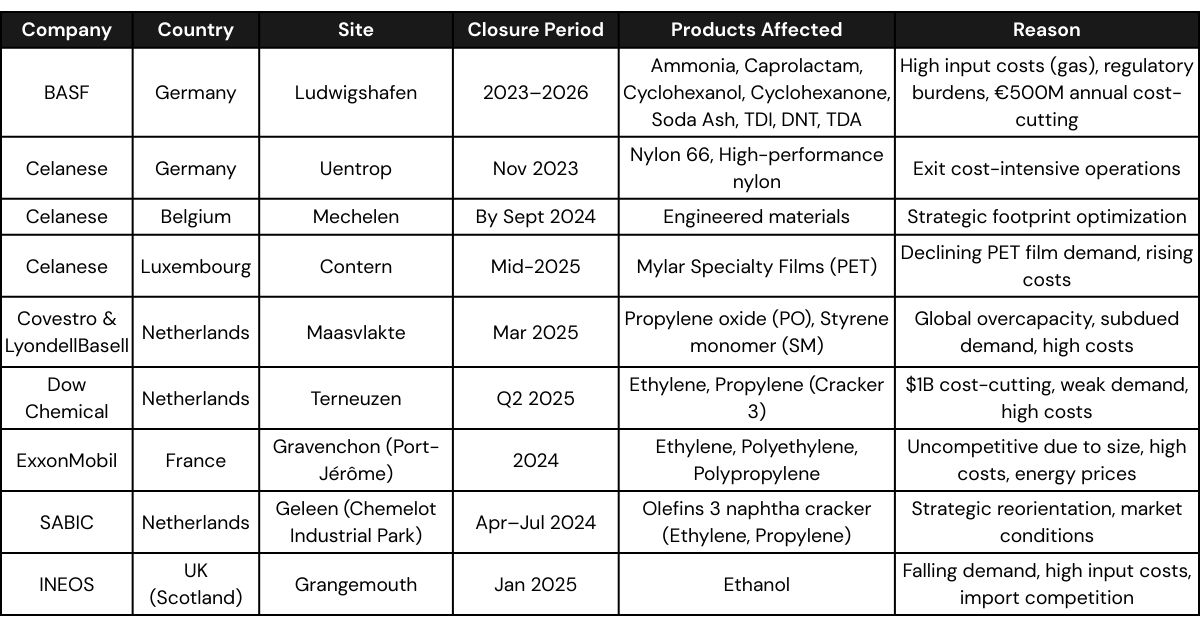
Recent closures over Europe’s chemical sector depict the growing pressure facing specialty chemical manufacturers. One of the most prominent examples is BASF, which announced a series of significant plant closures at its flagship Ludwigshafen site in Germany. The affected facilities encompass those producing ammonia, caprolactam, cyclohexanol, cyclohexanone, soda ash, and toluene diisocyanate (TDI), along with upstream units for dinitrotoluene (DNT) and toluenediamine (TDA). These closures, set up between 2023 and 2026, are part of a broader cost-cutting initiative to reduce fixed costs by over €500 million annually. The company cited unsustainable input costs, especially because of rising gas prices, and ascending regulatory compliance burdens as key drivers. Approximately 700 production jobs are expected to be impacted.
Celanese has also initiated a series of closures across Europe. In November 2023, the company announced the shutdown of its Nylon 66 and high-performance nylon production units at the Uentrop site in Germany. In consequence of this, a decision was taken in March 2024 to close its engineered materials facility in Mechelen, Belgium, with operations set to cease by the end of September 2024. In February 2025, Celanese confirmed the closure of its Mylar Specialty Films manufacturing facility in Luxembourg, as part of its strategic shift toward lower-cost, high-productivity sites. These back-to-back shutdowns show an intended effort to exit cost-intensive operations and lower the company’s global footprint.
In March 2025, Covestro and LyondellBasell jointly revealed the permanent closure of their PO11 unit at the Maasvlakte site in the Netherlands. The plant produced propylene oxide (PO) and styrene monomer (SM), key agents in the production of polyurethanes and plastics. This decision was swayed by global overcapacity, falling demand, and rising operating costs in Europe, making continued production economically impracticable.
Dow Chemical also disclosed a notable restructuring initiative in January 2025, with a target to deliver US$ 1 billion in cost savings. While the company did not specify all site-level impacts publicly, its Belgian operations are understood to be part of the plan. Dow’s strategic focus is now centered on enhancing capital efficiency and optimizing its global manufacturing network, particularly in light of slower-than-expected economic recovery in Europe and Asia.
In the petrochemicals space, ExxonMobil and SABIC both made headlines with closures tied to high costs and structural oversupply. In April 2024, ExxonMobil revealed the shutdown of its Gravenchon site in France, mentioning an unfavorable cost structure. In a similar manner, SABIC disclosed its intention to close one of its naphtha-fed crackers in Geleen, the Netherlands, as the economics of operation in the current market environment proved unsustainable.
Another notable example is INEOS. It stopped ethanol production at its Grangemouth site in Scotland in January 2025. The closure led to the direct loss of 80 jobs. Also, it impacted hundreds more in supporting industries. INEOS pointed the decision was because of falling European demand, rising input costs, and competitive pressures from imported ethanol.
In addition to these high-profile cases, many small and medium-sized specialty chemical manufacturers have exited the market, especially those focused on fine chemicals, epoxy resins, fluorochemicals, and high-purity solvents. These shutdowns have had a compounding effect on downstream industries, which depend on these materials for pharmaceutical formulations, coatings, adhesives, electronics, and advanced composites.
Together, these case studies show a broader structural recalibration within the European specialty chemicals sector. Economic pressures, energy instability, and stringent environmental expectations are reshaping the regional manufacturing landscape, triggering both strategic repositioning and capacity withdrawal.
Supply Chain Disruptions and Industry Responses
The recent wave of plant closures has triggered significant supply chain disruptions across key European industries. In the pharmaceutical sector, insufficiency of critical intermediates and excipients has led to production delays and rising reliance on imports. Similarly, the electronics and automotive sectors are facing difficulties sourcing specialty chemicals essential for coatings, adhesives, and semiconductor manufacturing. These disruptions have extended lead times, raised costs, and heightened Europe’s dependency on suppliers in Asia and North America, intensifying concerns about quality control and geopolitical risks. Agriculture has also been affected , with reduced availability of crop protection intermediates nudging operational costs for producers.
As a reply, companies are implementing a variety of mitigation strategies. Some are pursuing reshoring and onshoring efforts to rebuild domestic capacity, though these efforts are constrained by Europe’s high energy costs and stringent regulatory environment. Supplier diversification has gained momentum, with firms progressively sourcing from Eastern Europe, India, and North Africa. Dual sourcing strategies are also being embraced to lessen geographic dependency. In parallel, R&D initiatives are exploring alternative synthesis routes and green chemistry approaches to substitute vulnerable inputs. Some companies are stockpiling critical materials to buffer against more shocks in coming times. At the same time, others are putting finances in AI-driven supply chain management tools to predict disruptions, streamline procurement, and optimize inventory levels.
Environmental and Strategic Policy Considerations
The larger outcomes of offshoring chemical production are now coming into sharper focus. A key concern is carbon leakage. Here, emissions reductions achieved within Europe are offset by higher emissions in less regulated production areas. This dynamic threatens the objectives of the European Green Deal. Also, it casts doubt on the net environmental benefit of current policy approaches. At the same time, the closure of specialized chemical facilities risks eroding Europe’s base of technical expertise and innovation capacity in advanced chemistry. As pilot plants, R&D labs, and production hubs shut down, the region may lose its competitive edge in high-value chemical development.
There is growing unity that present-day policy frameworks may need rebalancing. While environmental regulation remains vital, many stakeholders argue for a more supportive industrial policy, one that ensures sustainability targets are met without sacrificing strategic manufacturing capabilities. Emerging proposals include EU-level funding for green process innovation, transitional subsidies for energy-intensive operations, as well as measures to safeguard innovation hubs. Such actions are now more seen as essential to prevent further deindustrialization and to maintain Europe’s leadership in advanced materials and chemical technologies.
Outlook and Recommendations
If the trend of shutdowns continues unchecked, Europe could face a long-term decline in its specialty chemicals sector. This would raise strategic dependencies on imports, reduce its influence in global value chains, and weaken its innovation capacity.
To reverse this, targeted policy reforms are needed. These could be energy cost relief for strategic industries, streamlined regulatory pathways for low-carbon technologies, and incentives for green chemistry research and implementation. Supporting pilot-scale facilities and SME innovation hubs could help narrow the gap between laboratory science and commercial production.
Most importantly, collaboration among regulators, industry leaders, and academic institutions will be very important. Together, they can co-develop a framework that aligns environmental sustainability with economic and industrial resilience.
Wrapping Up
The recent closures of specialty chemical plants across Europe are the result of a complex interplay between rising energy costs, stringent environmental policies, economic competitiveness, and global supply chain dynamics. These shutdowns have already begun to reshape the supply scenario for key downstream sectors, calling attention to shortcomings that need urgent attention.
Balancing environmental ambitions with industrial sustainability is not just a policy challenge but a strategic imperative. With the right mix of innovation, investment, and regulatory foresight, Europe can maintain its leadership in specialty chemicals while transitioning toward a more resilient and sustainable industrial future.