The global functional beverage market is expanding rapidly. It is driven by rising consumer interest in health-oriented, nutrient-enriched drinks. In the United States alone, the performance and sports drinks category is projected to reach $19.5 billion in 2024, with forecasts indicating growth to $27.5 billion by 2028. This shows sustained consumer demand for beverages that deliver benefits like energy, hydration, and cognitive support.
These beverages are formulated with a variety of bioactive ingredients such as vitamins, minerals, polyphenols, probiotics, and plant extracts that offer potential health benefits. However, putting these compounds into beverages poses substantial formulation challenges due to their poor water solubility, instability under processing conditions, and limited bioavailability in the human body.
To address these issues, researchers and ingredient suppliers are investigating polymer-based encapsulation systems as a promising approach for the protection and targeted delivery of bioactives. Although not yet widely commercialized, smart polymer encapsulation technologies are gaining attention in food science for their potential to improve nutrient stability, enhance solubility, and enable controlled release in liquid formulations.
Polymer Encapsulation Systems for Nutrient Protection
Encapsulation using food-grade polymers is a technique being studied to safeguard bioactive ingredients from environmental and processing stresses. Commonly researched encapsulating agents are polysaccharides such as alginate, pectin, modified starch, and chitosan, as well as proteins like whey, casein, and soy isolates. These materials can form gel-like matrices or coatings around active compounds, offering physical and chemical protection.
Lipid-based polymers are also being evaluated. This is particularly for fat-soluble bioactives like omega-3 fatty acids. These systems can improve dispersion in aqueous media along with helping prevent oxidative degradation. These encapsulation systems show promising results in laboratory and pilot-scale settings. But adapting them for large-scale beverage production remains a complex challenge.
There are several encapsulation approaches that are under active investigation in R&D settings. Microencapsulation and nanoencapsulation are the most explored techniques. These are the techniques that allow active ingredients to be enclosed within polymeric shells or embedded within matrix structures at micro- or nanoscales, offering better control over their stability and release.
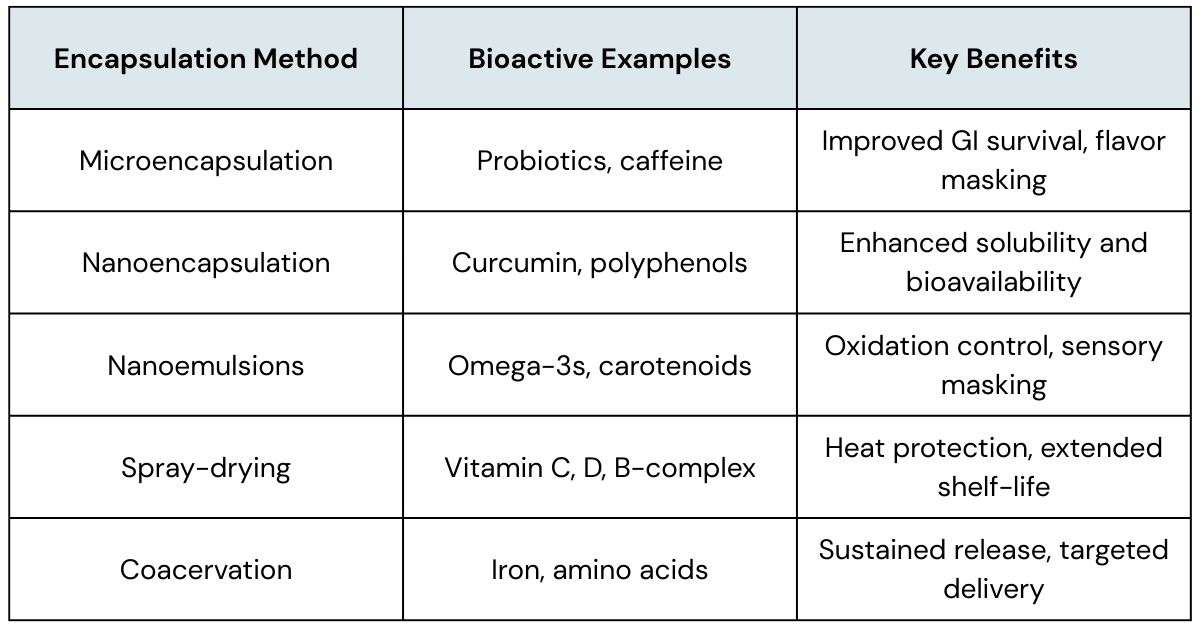
For example, studies have shown that microencapsulation of probiotics using alginate-chitosan matrices can notably improve survival rates through gastrointestinal transit. On a similar note, nanoencapsulation of curcumin using lipid-polymer nanocarriers has shown enhanced solubility and antioxidant activity in model beverage systems.
Emulsion-based encapsulation is also being examined, especially for ingredients like omega-3s and polyphenols. Using protein- or polysaccharide-based emulsifiers, researchers have created stable nanoemulsions that prevent oxidation and mask undesirable flavors in liquid formulations.
Other methods under exploration include spray-drying of heat-sensitive compounds like vitamin D, using modified starch carriers, and complex coacervation to encapsulate caffeine or iron for sustained release. These techniques offer functional benefits, but they need specialized infrastructure and careful formulation design. This limits their immediate scalability.
Potential Applications in Functional Beverage Development
If successfully scaled, smart polymer encapsulation systems could open new frontiers in functional beverage innovation. To give an example, encapsulated probiotics could enhance viability in fermented drinks such as kombucha or oat-based yogurt beverages. In a similar manner, encapsulated antioxidants and polyphenols may offer enhanced shelf-life and bioefficacy in berry or green tea-based drinks.
Encapsulation could also benefit vitamin- and mineral-fortified beverages by protecting compounds like vitamin C, D, or B-complex from thermal degradation during processing. Omega-3-enriched dairy and plant-based milks could avoid off-flavors and rancidity using lipid-polymer coatings. In sports and nutritional drinks, stabilized amino acids and electrolytes could give more consistent functionality and sensory appeal.
However, these applications currently remain theoretical or in the prototype stage, pending further validation and commercial development.
Barriers to Commercial Adoption: Why Smart Encapsulation Isn’t Mainstream Yet
One of the major hurdles to commercial adoption is regulatory uncertainty. While some biopolymers like alginate and pectin are generally recognized as safe (GRAS), others, particularly synthetic or engineered polymers, require rigorous evaluation by authorities such as the FDA or EFSA. Additionally, encapsulated ingredients often need to be assessed not only for safety but also for their bioavailability and release profiles, adding to the regulatory complexity.
The cost of implementation is high. Creating encapsulated bioactives involves advanced equipment, purified polymers, and controlled production environments, all of which drive up formulation costs. These costs may not be feasible for companies operating in price-sensitive categories. Also, process compatibility is an issue. Some functional beverages undergo heat processing, such as pasteurization or UHT. This can damage or destabilize delicate encapsulated structures. Adapting existing manufacturing lines to accommodate these systems needs significant investment. There are also regulatory and labeling limitations. Many encapsulation materials are not yet approved in all markets. Even those that are may raise concerns around ingredient disclosure along with clean-label marketing. This creates hesitation among product developers.
Additionally, the lack of a mature supplier ecosystem means that most beverage brands cannot simply purchase off-the-shelf encapsulated actives suited to their products. Custom development is often needed. This slows down time-to-market and increases R&D risk. Also, long-term validation studies are essential. Brands need to showcase not only the stability and efficacy of encapsulated ingredients but also safety, shelf-life, and consumer acceptability. These requirements expand development timelines and lower the chance of rapid adoption.
Industry Activity and Investment Timeline
Several leading companies and research institutes have been actively exploring smart polymer encapsulation technologies to enhance bioactive delivery in functional beverages. PepsiCo, a global beverage giant, signaled its interest in this space as early as September 2022, when it issued an open call for novel encapsulation technologies aimed at improving ingredient stability, solubility, and sensory performance in acidic beverage systems. In July 2024, materials innovation company Xampla partnered with the Yili Innovation Centre Europe to pilot its microscopic, plant-based polymer capsules designed to preserve sensitive vitamins and nutrients in dairy products like milk and yogurt. Meanwhile, the Nano and Advanced Materials Institute (NAMI) continues to advance proprietary encapsulation platforms for food and beverage applications. While exact dates for NAMI’s developments are not disclosed, their work focuses on delivering bioactives through microcapsule powders with controlled release properties.
In the investment sphere, Constellation Brands made a significant move in November 2024 by announcing a minority investment in Hiyo, a rising non-alcoholic functional beverage brand using adaptogens, nootropics, and botanicals. This strategic partnership was publicly disclosed in February 2025, with additional details surfacing in March 2025 through industry coverage, underscoring the company’s commitment to expanding into the wellness-driven drinks category.
These developments highlight growing commercial and research interest in encapsulation systems, signaling a shift from theoretical promise to real-world implementation in the near future.
Wrapping Up
Smart polymer encapsulation has great potential for overcoming long-standing formulation challenges in the functional beverage industry. By enhancing the stability, solubility, and bioavailability of sensitive nutrients, these technologies could bring the next generation of health drinks that are more effective and shelf-stable.
But their current application remains limited to research environments and select ingredient suppliers. Regulatory frameworks are undergoing changes, consumer understanding is maturing, and production technologies are becoming more cost-efficient. This will likely improve the commercial viability of smart encapsulation.
Until then, polymer-based delivery systems remain one of the most promising yet underutilized innovations in the progressing field of functional beverages.