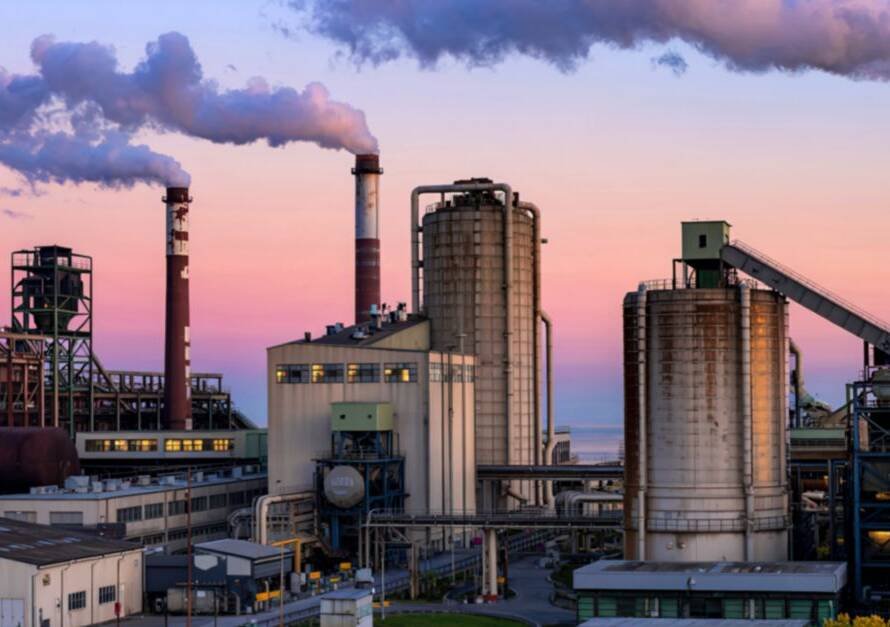
Following the oil and gas industry, the paint and coatings industry is the second largest contributor to global VOC emissions. Paints and coatings contain 40–65% volatile organic compounds (VOCs). The most prevalent volatile organic compounds (VOCs) in this industry are xylene, toluene, and ethylbenzene; they are usually used as solvents to aid in the dissolution and dispersion of other ingredients. Other hazardous substances used in paint and coating manufacturing include PFAS, phthalates, lead, and chromium.
Utilizing bio-based raw materials is one of the newest technologies and approaches, as it lessens dependency on fossil fuels and the production process’s carbon footprint. These raw materials come from renewable resources like algae and plant oils. The focus is on environmentally friendly techniques like low-VOC & zero-VOC coatings, nanotechnology, and UV-curable coatings.
The Sustainability Drive In Paints and Coatings: Regulations
The idea of sustainability in the coatings industry has undergone a dramatic change over the years. Earlier, the emphasis was made primarily on the minimization of volatile organic compounds (VOCs). However, energy conservation, waste reduction, improved procedures, and the use of sustainable resources are all now integrated with sustainability aspects.
The EU leads with the strongest and most comprehensive regulatory momentum focused on sustainability. The Paints Directive is a European Union law aimed at reducing air pollution by limiting the amount of volatile organic compounds (VOCs) in certain paints and varnishes. The directive sets specific limits on the amount of VOCs allowed in these products. Paints and varnishes can contain between 30 and 750 grams of VOCs per liter, depending on the product type, and products must be labeled with information about their VOC content and the relevant limit for their category.
National Volatile Organic Compounds Emission Standards is a regulation issued by the U.S. Environmental Protection Agency (EPA) under the Clean Air Act. This regulation sets limits on the amount of volatile organic compounds (VOCs) that can be in paints and coatings used for buildings and structures and aims to cut VOC emissions by about 113,500 tons each year.
Recently, China’s Ministry of Industry and Information Technology has proposed a new standard to control harmful substances in paints and coatings used on buildings and has added two new limits for Arsenic and MIT (Methylisothiazolinone) and SVOCs (Semi-Volatile Organic Compounds). The exact numeric limits will be specified in the final version of the standard, which is still under review.
Sustainable Technologies Gaining Momentum in the Industry
– Waterborne Coatings (Water-based)
Waterborne coatings are environmentally friendly paints that use water as the main solvent, making up 80% of the total solvent. The coatings contain water-soluble resins that fully dissolve in water. It typically has VOC levels below 3.5 pounds per gallon, which is much lower when compared to traditional coatings. These work similarly to coatings based on solvents, but they take a lot longer to dry.
Clariant has developed new agents specifically designed to improve water-based coatings. These innovations aim to simplify the formulation process and enhance the performance of these coatings by offering the right thickness and consistency. Recently, Axalta Coating Systems has launched Cerulean™, a new line of water-based industrial wood coatings. It mimics solvent-based coatings and has low VOC content (less than 200 grams per liter).
SiO New Material (SIOResin) has launched a new line of water-based matte polyurethane resins designed for various industries, including coatings. This new launch meets strict global VOC emissions standards. Arkema is developing resins and additives derived from renewable sources, including UV-LED-EB-curable resins and waterborne resins, with up to 97% bio-content. The company is also creating powder coatings with up to 40% recycled content, specifically using recycled PET (rPET). These technologies are still in the development stage and have not yet been commercialized.
– Powder Coatings
Powder coatings are a method of applying a dry, powdered material to a surface rather than using traditional liquid paints. The powder is sprayed onto the surface using an electrostatic gun, which helps the powder stick. It is then heated in an oven to make the powder particles melt and fuse together, creating a strong, durable coating, and up to 98% of the powder overspray can be recovered and reused. One major drawback can be that achieving precise color matching and maintaining uniform coating thickness can be challenging. AkzoNobel has developed a new range of sustainable powder coatings called Interpon D Natural Metals. This new product contains no VOCs.
In addition to lowering VOC emissions, businesses are developing new sources to make coatings. For example, Axalta Coating Systems has launched a new line of sustainable powder coatings called Alesta BioCore, which is made from organic waste that is not food. It is designed for industries seeking to reduce scope 3 emissions. This range uses patented particle technology to create a deeper, more vibrant metallic finish compared to traditional powder coatings. The EV industry is seeing a surge in popularity for powder coatings, and companies are investing in new product launches that have the potential to drive the industry.
– UV-Curable Coatings
UV-curable coatings use ultraviolet (UV) light to quickly cure and harden the coating, requiring less energy than traditional thermal curing processes. However, these coatings have low viscosity, which can make it difficult to achieve the desired thickness and uniformity upon application. However, it is a new technology in the EV industry because it provides outstanding thermal stability, preventing coatings from affecting the battery’s electrolyte solution—a significant issue in the EV industry at the moment. PPG has introduced the PPG DURANEXT™ portfolio, a new line of fast-curing coatings for metal surfaces. These coatings use electron beam (EB) and ultraviolet (UV) light to dry almost instantly, which is much faster and more energy-efficient than traditional high-temperature methods.
Nissan is testing a new paint designed to keep cars cooler in the summer and reduce air-conditioning use. Developed in collaboration with Radi-Cool, this paint uses special materials to reflect sunlight and manage heat. By keeping the vehicle’s interior cooler, it reduces the need for air conditioning and lowers energy consumption.
In a Nutshell
Among sustainable coatings, waterborne and UV-curable coatings stand out for their reliability. As a potential remedy for EV battery issues, UV-curable coatings are becoming more and more popular. Enhanced collaboration between companies can accelerate innovation and standardization across the industry. Innovations in biotechnology and nanotechnology could help the sustainable paints and coatings sector in the years to come. Bioengineered materials and advanced nanomaterials could offer improved functions while lowering reliance on conventional solvents.