A Shift in the Aroma and Taste Molecule Playbook
For most of the 20th century, the backbone of fragrance and flavor creation rested on three pillars: petrochemical synthesis, plant extractions, and animal-derived ingredients. Iconic molecules like vanillin were once upon a time extracted from clove or synthesized from lignin, while musk and civet were derived from deer glands and civet cats respectively. These were, no doubt, luxurious but at the same time controversial components. In the flavor industry, grapefruit oil for nootkatone and orange blossoms for methyl anthranilate showcased the reliance on botanicals for vibrant, natural tastes.
Over the decades, however, consumer expectations evolved. Today, the fragrance and flavor industries are going through a complex landscape shaped by sustainability imperatives, ethical sourcing concerns, and heightened regulatory oversight. Consumers increasingly demand transparency in product labeling, seeking out ingredients that are natural, vegan, halal, kosher, and environmentally responsible.
In this shifting terrain, biotechnology has come up as a transformative force. Once considered a promising but impractical laboratory tool, fermentative and enzymatic synthesis has now matured into a viable industrial strategy. These approaches are not only replacing controversial and resource-intensive methods but are also expanding the possibilities for creating high-value aroma compounds with precision, efficiency, and sustainability at their core.
What’s Changed: Why This Is Now Commercially Viable
The move from curiosity to commercial-scale fermentation latches on a few technological breakthroughs. The field of metabolic engineering, especially synthetic biology, has advanced to the point where microbial strains can be programmed like factories. Precision gene editing allows these microbes to convert simple sugars or plant-based precursors into complex aroma molecules with high specificity.
Along with improvements in fermentation infrastructure and microbial optimization, companies can now achieve notably higher yields in scalable bioreactors. Process controls allow for fine-tuning environmental variables like pH, oxygen, and nutrient levels, ensuring consistent product quality and reproducibility across batches.
Most importantly, the cost curve is catching up with traditional chemical synthesis and extraction methods. Where once bio-based approaches were prohibitively costly, advances in strain efficiency and downstream processing have narrowed the gap. In some cases, especially for low-yield natural extracts such as nootkatone, fermentation is not only competitive but actually preferable.
There is also a regulatory and marketing edge. In both the U.S. and EU, molecules produced via fermentation or enzymatic conversion from natural sources can be labeled as “natural.” This gives a clean-label advantage and aligns with growing consumer preferences for plant-based, non-GMO, allergen-free, vegan, and halal-certified products. Also, fermentation typically requires less land, emits fewer greenhouse gases, and avoids the use of harmful solvents, marking a significant sustainability win.
Key Molecules Going Bio-Based: Flavor & Fragrance Synthesis at a Crossroads
A growing list of high-impact aroma molecules is now being produced via fermentative or enzymatic means. Take vanillin, for example. Traditionally sourced from vanilla beans or synthesized from guaiacol and lignin, vanillin is now produced through microbial conversion of ferulic acid. It is an abundant compound in rice bran and corn. Companies such as Evolva, IFF, and Conagen are at the front of this transition. How? By supplying vanillin for bakery, dairy, and beverage applications, as well as base notes in perfumes.
Nootkatone, a prized grapefruit compound, has long suffered from supply issues because of the low yields from citrus peel. Its fermentation from valencene, a precursor derived from orange oil, has made production scalable and cost-effective. Companies such as Isobionics and BASF have brought this technology to market, targeting citrus beverages, chewing gum, and fresh, uplifting fragrance blends.
Ionones, which deliver floral and berry notes, are now being produced via enzymatic cleavage of carotenoids. Givaudan has pushed this approach forward. They enabled consistent production for both confectionery flavors and violet accords in perfumery.
There are other breakthroughs as well. It includes Firmenich’s bio-based ambrettolide and civetone, musk substitutes once derived from ambrette seed and civet glands. These molecules, now synthesized via fermentation from sugars, meet ethical, regulatory, and olfactory requirements without relying on animal sources.
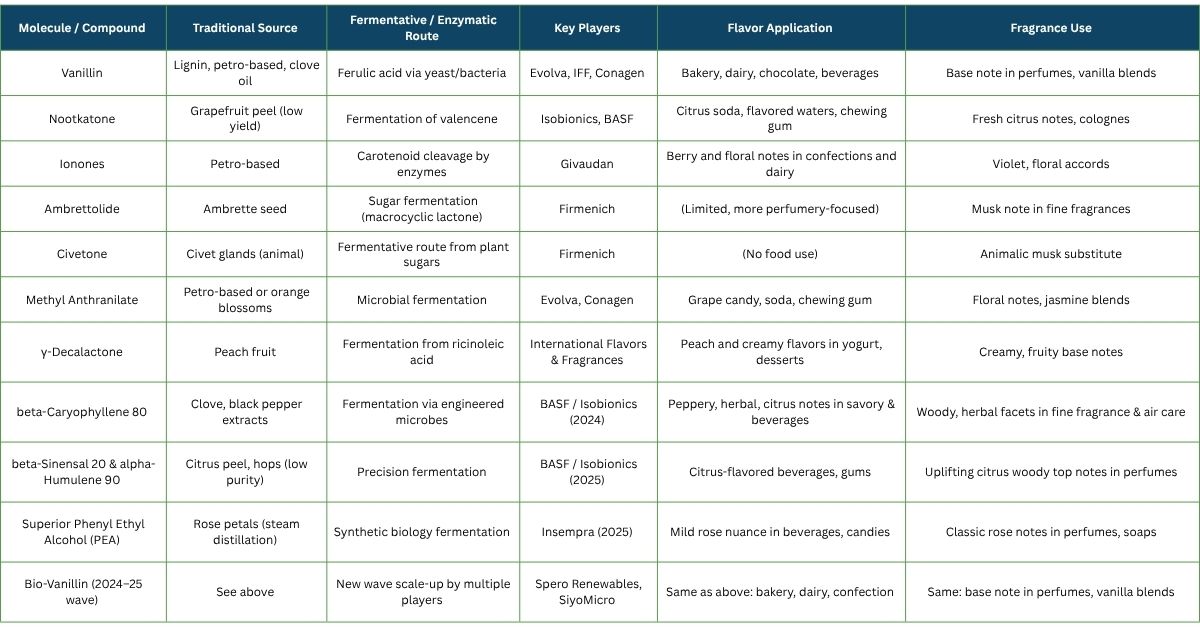
Methyl anthranilate, known for its grape candy and jasmine-like aroma, is also transitioning from petrochemical or orange blossom origins to microbial fermentation. Evolva and Conagen are producing it at scale for use in candies, sodas, as well as floral fragrance compositions.
Even γ-decalactone, responsible for the creamy peach scent in desserts and perfumes, is now produced through the fermentation of ricinoleic acid. This route, made by IFF and others, make sure a stable, scalable, and natural supply chain.
Industry Spotlights: Who’s Leading the Charge?
Several leading companies are now steering this biotechnological revolution in flavors and fragrances with remarkable launches between 2024 and 2025. In March 2024, BASF and its Isobionics division introduced beta-Caryophyllene 80, a precision-fermented terpene that brings peppery, herbal, and citrus nuances to both savory and beverage applications while delivering woody, green facets to perfumery and air care. By October 2024, Spero Renewables and SiyoMicro Biotech showed their latest bio-vanillin innovations at Flavorcon. They highlighted fermentation-based vanilla profiles attuned for clean-label confectionery and dairy products, as well as warm, sweet notes in fine fragrances and personal care.
Moving into March 2025. BASF stretched this portfolio further by bringing in beta-Sinensal 20 and alpha-Humulene 90, citrus-woody compounds formed to enrich everything from citrus beverages to uplifting fragrance compositions. Finally, in April 2025, Insempra unveiled its Superior Phenyl Ethyl Alcohol (PEA), a mild rose-type molecule produced via synthetic biology, equally suited for bright floral layers in beverages and confectionery as for elegant rosy notes in perfumery and cosmetics. Together, these innovations show how fermentation and enzymatic technologies are bridging the historical divide between flavor and fragrance industries. This also unlocks dual-purpose aroma molecules that deliver on both sensory delight and sustainability.
Analytical & Technical Advances Enabling This Shift
The success of fermentative and enzymatic synthesis relies on the microbial workhorses as well as on the analytical and process technologies. Why? As it ensures precision, safety, and performance. Modern bioreactors are fixed with real-time control systems. It helps in regulating pH, temperature, aeration, and nutrient feed. These parameters are a great deal to maintaining optimal yields and preventing contamination or metabolic drift.
Analytical techniques play a crucial role in validation. FTIR, i.e., Fourier-transform infrared spectroscopy and NMR, i.e., nuclear magnetic resonance) confirm molecular identity and purity. GC-MS (gas chromatography–mass spectrometry) and GC-Olfactometry are needed for profiling the volatile components that define aroma and flavor. These methods also detect trace impurities that could affect perception or regulatory compliance.
For chiral molecules, where one enantiomer may smell sweet and the other sour, chiral analysis make sure the desired stereoisomer is produced with high specificity. This is important in flavor development where even small changes can disrupt taste profiles.
Stabilization and delivery systems are also moving with the time. Encapsulation techniques such as cyclodextrin inclusion and spray-drying improve the shelf life of volatile bio-aromas. In food systems, liposomal or biopolymer encapsulation allows controlled release, preserving flavor intensity during storage and cooking.
In Europe, Regulation (EC) No. 1334/2008 defines “natural flavoring substances” as those obtained by appropriate physical, enzymatic, or microbiological processes from natural sources. This regulatory framing positions fermentation-derived ingredients as both natural and compliant with strict labeling laws.
Regulatory Green Lights & Clean-Label Market Pull
The regulatory environment is now more suited for bio-based aroma compounds. In the U.S., several biotech-derived flavors have got GRAS (Generally Recognized As Safe) status, including Evolva’s nootkatone. This status allows manufacturers to use these ingredients without lengthy pre-market approval. This also accelerates product development cycles.
In Europe, Regulation (EC) No. 1334/2008 mentions “natural flavoring substances” as those obtained by appropriate physical, enzymatic, or microbiological processes from natural sources. This regulatory framing positions fermentation-derived ingredients as natural as well as compliant with strict labeling laws.
Organizations such as IFRA (International Fragrance Association) and REACH (Registration, Evaluation, Authorisation and Restriction of Chemicals) are also expanding support for bio-based ingredients. Why? Because they often present fewer toxicity and environmental concerns than petrochemical analogs.
Market momentum is strong. In the flavor space, there is growing demand for clean-label, vegan, and allergen-free ingredients, especially in plant-based foods, health drinks, and functional snacks. In perfumery and home care, clean beauty trends and sustainability concerns are molding interest in fragrances with transparent, natural origins and low environmental impact.
Outlook: From Specialty Innovation to Industry Standard
Looking forward in the time, a new generation of aroma molecules is entering development. These include sustainable alternatives to coumarin, which traditionally comes from tonka bean, eugenol analogs offering spicy, clove-like notes, and floral compounds like jasmine lactones and rose oxide that are being synthesized enzymatically for both cost and purity advantages.
But scaling remains a core challenge. As demand grows, so does the need for expanded bioreactor capacity, efficient downstream purification systems, as well as a robust global production network that can aid year-round manufacturing. The industry must also look after the logistics of transporting and storing these often temperature- or oxygen-sensitive molecules.
Business models are evolving accordingly. Ingredient suppliers are transitioning from commodity sales to IP-driven licensing, giving proprietary microbial strains or enzyme systems that grant partners exclusive access to rare or customized aroma profiles. Brands, in turn, are leveraging these innovations to tell richer stories about sustainability, traceability, and biotech-enabled design.
Terms like “bio-fermented,” “carbon-light,” and “ethically sourced” are no longer marketing fluff. They are becoming essential pillars of product identity in both the flavor and fragrance sectors.
Conclusion: Fermentative and Enzymatic Synthesis is Reshaping Both Fragrance and Flavor Pipelines
Biotechnology is no longer a peripheral innovation in the world of aroma molecules. It is becoming the central paradigm. From vanillin in chocolates to musk notes in fine fragrances, the fermentative and enzymatic synthesis of flavor and fragrance ingredients is redefining what is possible, what is ethical, and what is sustainable.
What was once a tale of two industries, flavor and fragrance, is converging on shared platforms and shared technologies. The result is a new class of high-performance, bio-based compounds that deliver on both sensory experience as well as environmental responsibility.
For brands and ingredient suppliers alike, the strategic opportunity is very huge. By accepting biotech synthesis, they can meet rising regulatory standards, satisfy clean-label demands, as well as unlock novel olfactory experiences. In doing so, they are not just responding to a trend! They are shaping the future of sensory design.