Sweet proteins derived from fruits are found to be a low-calorie natural substitute for other sweeteners. Unlike natural and artificial sweeteners, they induce the T1R2-T1R3 human sweet taste receptors, without the calorie payload. This particular characteristic has a significant interest in the health foods businesses.
Sweet proteins are now being used as replacements for high-calorie sugars and artificial sweeteners in a range of food categories. They add sweetness to drinks without providing calories. This makes them great for low-calorie beverages. In confectionery, they help create low-sugar chocolates and candies while maintaining the desired sweetness.
The demand for sweet protein is being driven by consumer’s need for natural, low-calorie sweeteners that do not cause insulin responses. This makes sweet proteins a potential substitute to artificial sweeteners such as saccharin and aspartame and also plant-based sweeteners to some extent. Innovations like sugar-free protein water and sparkling protein water are using sweet proteins to deliver a sweet taste without added sugars.
The Rising Trend of Sweet Protein
In the United States, Oobli has pioneered the commercial use of sweet proteins. In March 2024, Oobli received a “No Questions” letter from the FDA, affirming the GRAS (Generally Recognized as Safe) status of their brazzein-based sweetener. They also received FDA approval for sweet protein ‘Monellin’ Collaborations, such as their partnership with Ingredion in February 2025, which aims to accelerate the development of healthier sweetener systems. Amai Proteins is an Israel-based startup that uses precision fermentation to develop Designer Sweet Proteins. This brings to the table calorie-free sweetening solutions for various food and beverage applications.
Companies like Naturannova, MycoTechnology, and Sweegen are advancing the sweet protein space with innovative solutions. Naturannova’s Sweet Protein+ is 10 times sweeter than Stevia, with no aftertaste or glucose spike, and is being used in dairy and flavored water. MycoTechnology’s sweet protein from honey truffles is 1,500-2,500 times sweeter than sugar and aims to enter North American markets by 2025/26. Sweegen uses proteins like brazzein and thaumatin for calorie-free sweetness and flavor enhancement. This has gained regulatory approval in multiple countries.
Sweet proteins are increasingly being considered safe and natural alternatives to artificial sweeteners like saccharin, aspartame, cyclamate, and acesulfame-K. Current developments in biotechnology have made possible the production of sweet proteins. This is done through methods like precision fermentation that further enhance their commercial viability. In December 2024, the Fraunhofer Institute revealed the development of a protein-based sweetener produced via yeast fermentation. This highlighted its potential as a sugar substitute.
Top 4 Sweet Proteins Which are Reforming Food Applications
Thaumatin is one of the most used sweet proteins. It is known for its dual role as a high-intensity sweetener and flavor enhancer. It is approximately 2,000 to 3,000 times sweeter than sucrose. It has a unique ability to enhance umami and mask bitterness. This comes from its interaction with taste receptors. Also, this makes it a versatile choice for flavor modification. But its heat sensitivity above 70°C limits its application in baked goods.
Next is Miraculin. It stands out for its unique taste modifying properties. Unlike traditional sweeteners, it binds to sweet receptors and activates them in acidic environments. In turn, this makes sour foods taste sweet without adding calories. Despite its potential, Miraculin’s sensitivity to heat and pH changes strikes challenges in processing and formulation.
Brazzein is gaining popularity as a high-potency sweetener. It is 500–2000 times sweeter than sucrose. Its high heat, high solubility and pH stability make it apt for a number of applications. This includes acidic beverages and heat-processed foods. Developments in biotechnological production using recombinant microbial systems have made Brazzein more cost-effective. This is paving the way for broader market adoption.
Monellin is a sweet protein approximately 1,500–2,000 times sweeter than sucrose on a weight basis. Naturally found in the fruit of the West African shrub Dioscoreophyllum cumminsii, monellin consists of two non-covalently associated polypeptide chains, making it sensitive to heat and pH variations. To enhance its stability, researchers have engineered single-chain variants like MNEI. This exhibits improved thermal stability while retaining sweetness. Despite the progress, monellin’s sensitivity to heat and pH variations still faces challenges for its widespread application in processed foods.
How Does Sweet Protein Function?
Sweet proteins, such as thaumatin, brazzein, and monellin, bind to the T1R2-T1R3 receptors located on taste buds. Conventional sugars require high concentrations to activate these receptors. Whereas sweet proteins achieve this with minimal amounts due to their unique three-dimensional structures.
The molecular conformation of sweet proteins enables them to bind to the T1R2-T1R3 receptor complex. This triggers a signal transduction pathway that sends sweet signals to the brain. This binding is quite intense and long-lasting compared to traditional sugars or artificial sweeteners. Once bound, sweet proteins stimulate a sweetness that is usually several hundred to thousands of times sweeter than sucrose. The sweetness also lingers longer on the palate, enhancing flavor profiles, especially in complex food formulations.
Unique Taste-Modifying Properties
Curculin and miraculin are two of the unique sweet proteins which exhibit taste-modifying properties. On consumption, they temporarily alter taste perception, transforming sour tastes into sweet sensations.
Curculin acts as a sweetener on its own and enhances sweetness when sour foods are consumed, making lemons taste like sweet lemonade. Whereas, miraculin functions as a taste modifier rather than a sweetener. It binds to sweet taste receptors but only activates them in the presence of acidic and sour substances.
Can Sweet Proteins Become as Big as Plant-Based Sweeteners?
Plant-based options like stevia, monk fruit, and allulose have gained popularity as substitutes for artificial sweeteners. This is mainly because of their natural origin and lower glycemic impact. But, sweet proteins are becoming a strong competitor because of their unique molecular properties. This provides distinct advantages over plant-based counterparts.
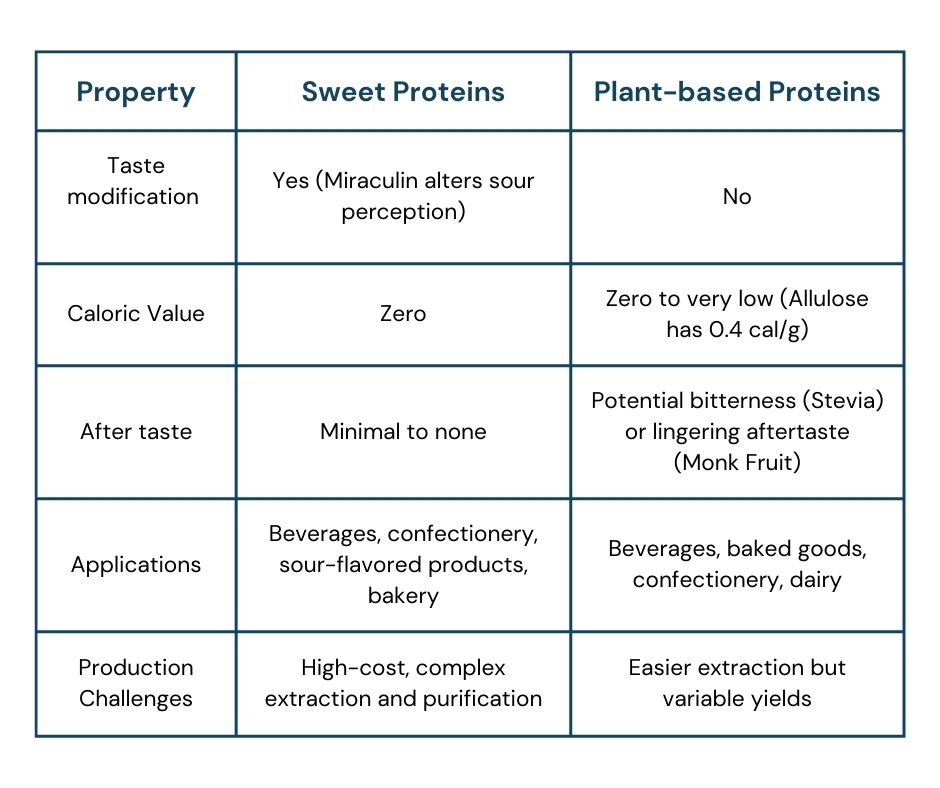
Sweet proteins demonstrate thermal and pH stability. This maintains sweetness even under processing conditions that can degrade plant-based sweeteners. Stevia can have a lingering bitter or metallic aftertaste. But sweet proteins mimic the temporal profile of sucrose. This gives a more sugar-like sweetness experience.
The sweet protein market is in its early stages but there is an assurance for its rapid growth as technology advances. As precision fermentation and recombinant protein production become more efficient, costs will decrease. This in turn will make them more accessible to food manufacturers. With ongoing investments from food tech startups and growing consumer demand for clean-label sweeteners, sweet proteins could very well come up as a mainstream choice.
Future Outlook
To remain competitive and keep up the innovation in the evolving sweetener market, manufacturers may explore the option of including sweet proteins in their product lines. The driver of this shift is the need to meet consumer demand for healthier, natural sweeteners without compromising taste.
Sweet proteins have the potential to bring notable changes to the food industry. But clear regulations are needed as scientists continue to study their safety and effectiveness. These studies need to progress faster because sweet proteins might serve as both a protein and a natural sweetener, thereby offering a healthier alternative for food products. If approvals come through in near time, we could see more innovative and health-focused products on the market.