Retinoid Instability and the Need for Advanced Delivery Systems
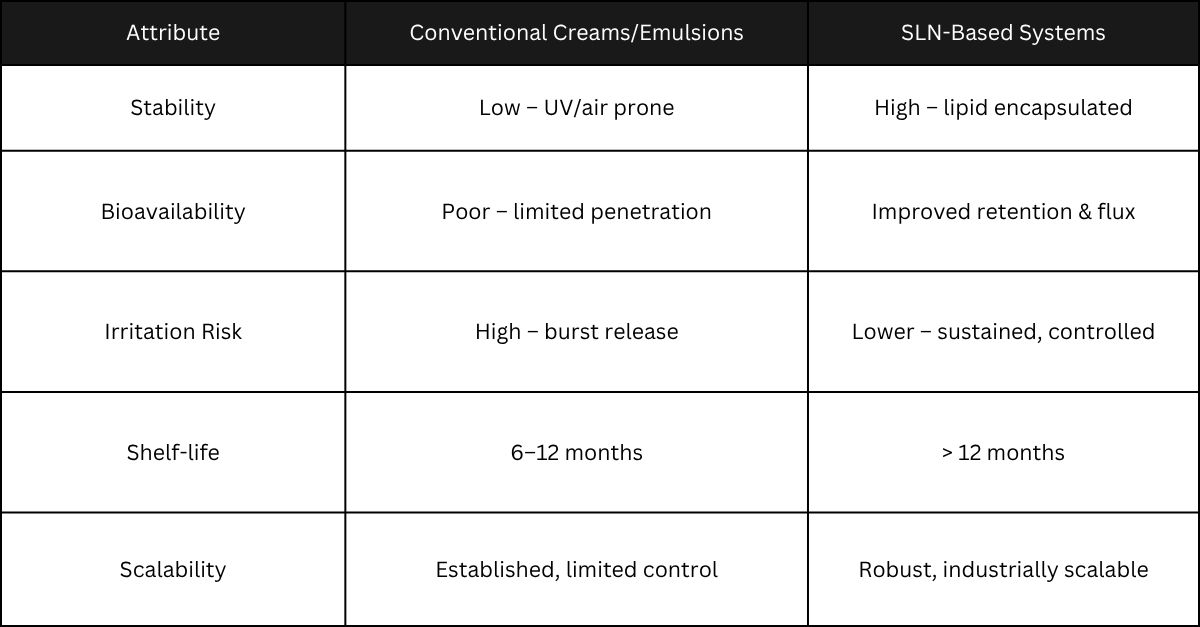
Retinoids, named retinol, retinaldehyde, and tretinoin, are among the most well-studied actives in dermatological science. They are known for their ability to promote epidermal turnover, stimulate collagen synthesis, and visibly reverse photodamage. Despite their proven track records in efficacy, retinoids remain notoriously complex to formulate. This is due to their instability when exposed to oxygen, light, and high temperatures. These compounds undergo quick degradation. Thus, they lose both potency and safety in conventional cream or emulsion systems. What makes this challenge more complex? It is the high incidence of irritation, often resulting from burst release profiles and poor penetration dynamics that deposit concentrated actives in the stratum corneum, triggering erythema, dryness, and peeling. Standard delivery formats offer insufficient protection and lack the pharmacokinetic control needed to modulate release or improve bioavailability. As dermatology and cosmetic science shift toward precision delivery platforms, Solid Lipid Nanoparticles (SLNs) have come up as a clinically relevant and commercially viable solution to address these shortcomings.
Understanding SLNs: Lipid Nanocarriers Engineered for Precision and Protection
Solid Lipid Nanoparticles are submicron carriers typically ranging from 80 to 200 nanometers, composed of solid lipids that remain in a crystalline or semi-crystalline state at both room and body temperatures. These lipids, such as glyceryl behenate, cetyl palmitate, and stearic acid, are physiologically tolerated and form the structural matrix of the SLN. The lipid core is stabilized by surfactants like polysorbate 80, lecithin, or Poloxamer 188, which control particle dispersion and prevent aggregation. The encapsulation of retinoids within this solid lipid matrix plays a dual purpose. It physically cushions the active ingredient from oxidative and photolytic degradation. Second, it allows a slow, sustained release upon skin application. Unlike liposomes or emulsions, SLNs rather form an occlusive layer on the skin surface. Thereby, it enhances transepidermal hydration, temporarily disrupts the stratum corneum’s lipid structure, and allows deeper diffusion of the payload. This occlusive and mimetic behavior, coupled with the ability to tightly regulate payload kinetics, makes SLNs as superior vehicles for delivering labile molecules such as retinoids.
Mechanistic Advantages: How SLNs Improve Stability, Bioavailability, and Tolerability
The performance of SLNs in retinoid delivery comes from their ability to step in at multiple mechanistic levels. Upon topical application, the nanoparticle dispersion quickly forms a lipid film that reduces transepidermal water loss and increases hydration in the superficial layers of the epidermis. This hydrated state supports the passive diffusion of encapsulated actives by softening the stratum corneum’s tightly packed lipid bilayers. At the same time, the solid lipid matrix protects the retinoid from oxygen and UV radiation. Thus, it minimizes common degradation pathways such as isomerization and peroxide formation. Because the active is embedded within a rigid lipid network, its release is governed by diffusion and matrix erosion, resulting in flattened pharmacokinetic curves. This not only extends the therapeutic window of the retinoid but also minimizes the concentration spikes responsible for irritation. Also, the lipid matrix composition can be designed to closely mimic the skin’s endogenous lipid profile. This enhances dermal compatibility and enables partitioning into deeper layers. This structural alignment with the stratum corneum’s architecture makes SLNs to bypass traditional barriers to penetration, giving superior delivery with markedly less inflammation or disruption of the skin barrier function.
Formulation Science: Engineering SLNs for Retinoid Encapsulation
Forming a stable SLN-based system for retinoids needs exact selection of lipid and surfactant. It also needs optimized processing approaches as well as careful characterization. Glyceryl behenate is mostly the lipid that is chosen. This is because of its high melting point, crystalline nature, and compatibility with lipophilic actives. Cetyl palmitate and stearic acid are also much used to give structural rigidity and add to encapsulation efficiency. Surfactants such as Tween 80 and lecithin lower interfacial tension, stabilize particle formation, as well as influence both particle size and zeta potential, critical parameters for predicting colloidal stability. In an ideal sense, particle sizes are maintained in the 100–200 nm range, with zeta potentials exceeding ±30 mV to avoid aggregation. Encapsulation efficiencies for retinoids in optimized SLN systems routinely exceed 80–90%, ensuring minimal free drug release on application and maximal protection during shelf life. Production methodologies include hot homogenization, high-pressure homogenization, ultrasonication, and microemulsion template techniques. Each offers varied advantages in particle control and scalability. Comprehensive stability testing under accelerated conditions, including exposure to varying pH, UV light, and high temperatures, is important to validate the robustness of the encapsulation system.
Performance Comparison: SLNs vs. Traditional Retinoid Formulations
Use Cases and Regulatory Context
SLN-based retinoid systems are nowadays more used in cosmetics as well as pharmaceutical formulations. In cosmetic dermatology, SLNs are used in anti-aging serums, under-eye creams, and acne therapies to enhance skin texture and reduce signs of photoaging with minimal irritation. Pharmaceutical applications include treatment of hyperpigmentation, psoriasis, and actinic keratosis, where sustained delivery betters clinical outcomes and patient adherence. Regulatory agencies across the EU and US recognize the safety of lipids and surfactants used in SLNs. The Scientific Committee on Consumer Safety (SCCS) in the EU permits retinol use up to 0.3% in leave-on products, and SLN systems help ensure compliance by minimizing free active exposure. In the US, while prescription retinoids are subject to FDA drug regulations, cosmetic-grade retinol products formulated with SLNs fall within acceptable safety limits because of their low systemic absorption and minimal irritation risk.
Innovations and Outlook for SLN-Based Retinoids
Between 2024 and 2025, several high-profile skincare brands have launched next-generation retinol products that exemplify the shift toward controlled delivery systems such as SLNs. In May 2025, Obagi Medical brought in its Retinol + PHA Refining Night Cream, a dual-action formulation coupling encapsulated retinol with polyhydroxy acids. It is designed for slow release and improved tolerability, especially in sensitive skin. Elizabeth Arden launched its Retinol + HPR Ceramide Capsules in August 2024, making use of monodose encapsulation technology that blends pure retinol with Hydroxypinacolone Retinoate (HPR) and ceramides, targeting deeper delivery with reduced irritation. In a similar manner, in April 2025, IMAGE Skincare brought in the AGELESS+ Retinol Collection, built on a step-up retinol protocol where SLN-based delivery mechanisms allow consumers to gradually increase concentration exposure without compromising skin comfort.
These commercial examples underscore a broader trend: brands are investing in encapsulation science not only for efficacy but for consumer experience, longer shelf life, visible results, and improved tolerance. In the approaching time, SLNs will also be likely used in multifunctional delivery platforms including peptides, antioxidants, and responsive elements that trigger release based on skin conditions. Sustainability and AI-based formulation modeling will also hasten development cycles and innovation pipelines.
Conclusion: Redefining Retinoid Delivery with Lipid Nanotechnology
Solid Lipid Nanoparticles represent a vital advancement in the dermal delivery of retinoids. By resolving core formulation challenges: instability, irritation, and poor penetration; SLNs enable both improved clinical performance and superior consumer experience. Their biocompatibility, scalability, and regulatory acceptance make them an ideal platform for future innovation in cosmetic science and dermatology. As the industry continues to move toward personalized, high-efficacy skincare driven by nanotechnology, SLNs will remain at the forefront. It is all set to offer a stable, controlled, and targeted approach to one of the most potent and challenging classes of actives in skincare.